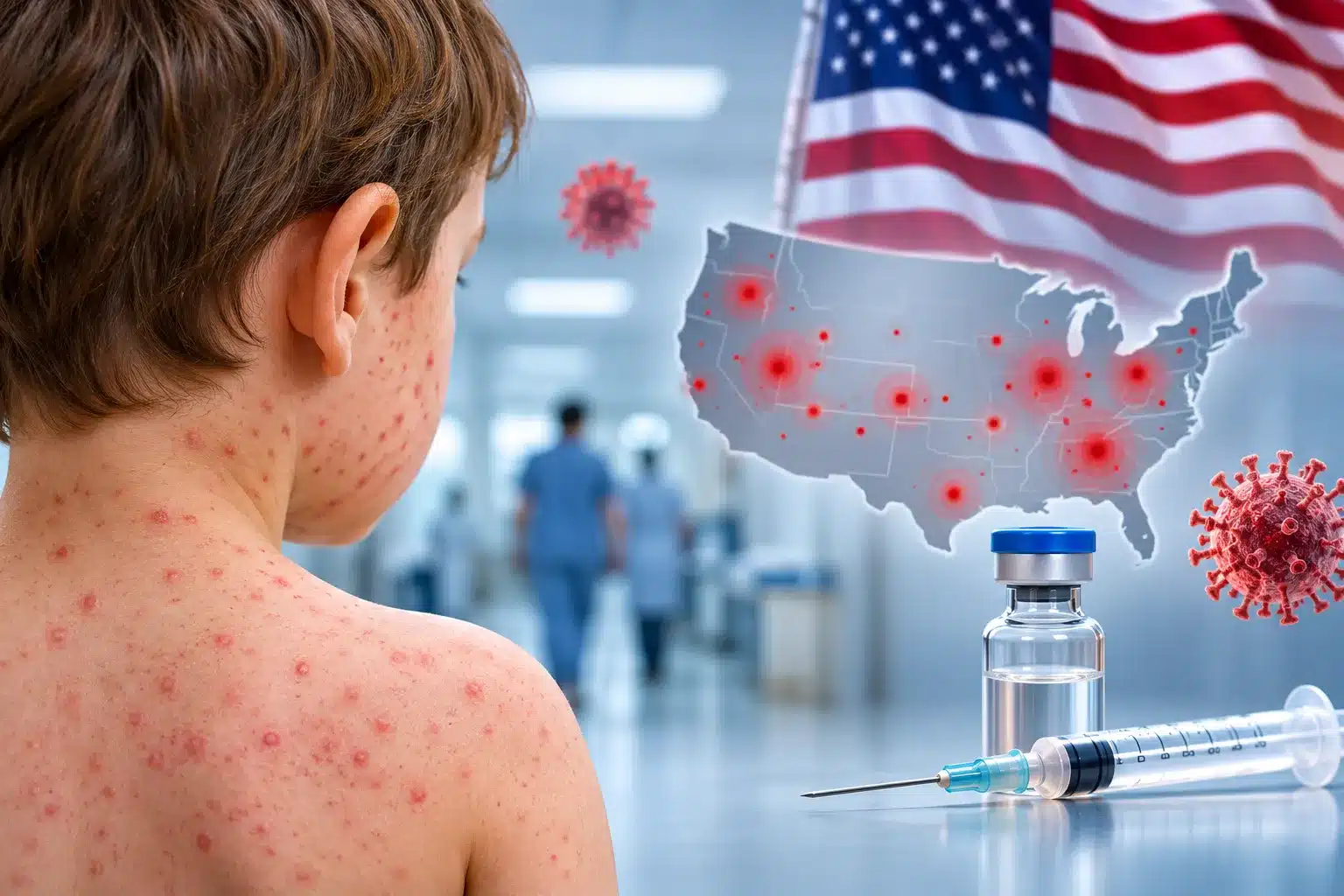
US Measles Crisis 2026: Cases Top 5,400 as Elimination Status Faces Review
The United States has recorded its worst measles year in more than three decades. As of November 13, 2026, the CDC counted 5,412 confirmed cases across 45 states, and state health departments have reported a string of measles-associated deaths, mostly among young children. Now an independent expert commission convened by the Pan American Health Organization (PAHO) has reportedly concluded that the country no longer meets the standard for measles elimination, a status it has held since 2000. Here is what the US measles outbreak 2026 means, and what comes next.
US Reports 5,412 Measles Cases and 10 Deaths
The CDC’s November 13 update listed 5,412 confirmed measles cases in 2026, an increase of 230 from the week before, ABC News reported. That is the highest annual total since 1991.
For perspective, the US averaged about 180 cases a year from 2000 to 2024. The country recorded 285 cases in 2024 and about 2,289 in 2025, which was itself a post-elimination record.
Other key CDC figures from early November:
- 43 new outbreaks reported in 2026.
- About 96% of cases were among people who were unvaccinated or whose vaccination status was unknown.
- About 95–96% of cases were linked to outbreaks.
- By age: 2,132 cases in adults 20 and older, 2,104 in people aged 5–19, and 908 in children under 5.
Death counts vary by source. As of November 13, state health departments had reported 10 measles-associated deaths: seven in Pennsylvania, two in Wisconsin, and one in New York. The CDC’s official count is lower, as explained below.
Has America Officially Lost Its Measles Elimination Status?
Not formally, at least not yet. On Friday, November 13, a source close to the process told CNN that PAHO’s independent Regional Verification Commission had determined the US no longer qualifies as having eliminated measles.
However, the commission only makes recommendations. Under PAHO’s process, the commission presents its findings to the PAHO Director, currently Dr. Jarbas Barbosa, who formally communicates the classification to national governments. The Associated Press reported that PAHO planned to announce the findings the following week.
The review was originally scheduled for April 2026 but was postponed to November at the request of US officials, who wanted more time to prepare genetic and epidemiological data. Mexico’s status was reviewed at the same meeting.
What Does Measles Elimination Actually Mean?
Measles elimination means there is no continuous, endemic spread of the virus within a defined area, such as a country, for at least 12 months. It does not mean zero cases. Travelers can still bring measles in, and small outbreaks can happen.
Eradication is different. It means the virus has been wiped out worldwide, as happened with smallpox. Measles has never been eradicated.
PAHO judges elimination largely through genetic sequencing. If the same measles strain keeps passing from person to person inside a country for 12 months or more, the disease is considered endemic again. Experts believe the US crossed that threshold in early 2026, linked to transmission chains that began with the West Texas outbreak in January 2025.
Why Measles Cases Are Rising Across the United States
Measles is one of the most contagious diseases known. One infected person can spread it to up to 9 out of 10 unvaccinated people nearby, and the virus can linger in the air for up to two hours.
Because of this, communities need about 95% vaccination coverage to prevent sustained spread. Outbreaks in 2025 and 2026 have clustered in close-knit communities where coverage is far lower. Rising nonmedical exemptions for school vaccine requirements, missed checkups during the pandemic, and growing vaccine hesitancy have all widened these gaps.
Once measles enters a pocket of low immunity, it can move quickly through schools, churches, and households, and then spread to neighboring communities.
Childhood Vaccination Rates Fall Below Critical Levels
Kindergarten MMR vaccination coverage fell from about 95% in 2019 to 92% in 2026, according to figures cited by ABC News. About 300,000 kindergartners started school this year without the vaccine.
State-level gaps are wide. Only 10 states reported kindergarten MMR coverage above 95% for the most recent school year, and 23 states were below 91%, Healio reported. Even states with high averages can have individual counties or schools far below the protective level.
Which States Have the Largest Measles Outbreaks?
Pennsylvania
Pennsylvania has the largest outbreak in the country, with 1,467 cases reported by early November and more than 200 hospitalizations. Cases have spread across more than 40 counties, with heavy transmission in Lancaster County and western rural areas. Read our earlier coverage of the Pennsylvania measles outbreak.
Utah and South Carolina
Both states have dealt with outbreaks of 500 or more cases. South Carolina’s outbreak, which began in 2025, was a key focus of concern for elimination status.
Wisconsin
Wisconsin is facing its largest outbreak in decades, with more than 250 cases confirmed by early October.
New York
New York had 178 confirmed cases in 2026 as of early November, mostly outside New York City. Gov. Kathy Hochul declared a statewide disaster emergency on October 5.
Cases have also been reported in 40 other states and Washington, D.C.
Measles Deaths Reported in Pennsylvania, Wisconsin and New York
Pennsylvania announced its first measles deaths in 35 years in August, involving two unvaccinated infants too young to be vaccinated. Four more deaths followed, including an 18-year-old and a 40-year-old woman. The sixth was announced November 4, and a seventh, an unvaccinated patient, on November 13.
On November 2, New York reported its first measles death in about 30 years, an unvaccinated 7-month-old in Lewis County. On November 5, Wisconsin reported an infant’s death, its first in 36 years. The state said the coroner listed measles as the immediate cause. A second Wisconsin infant death was reported on November 13.
The CDC’s official count is lower than the state totals. In 2026, the agency stopped automatically adding state-reported deaths and now counts only deaths where it has confirmed measles as the cause. As of November 13, the CDC listed six deaths. Pennsylvania Gov. Josh Shapiro has publicly disputed this approach. The US recorded three measles deaths in 2025, the first since 2015.
Why Measles Is More Dangerous Than a Common Rash
Measles usually starts with high fever, cough, runny nose, and red, watery eyes. A rash appears three to five days later, spreading from the face downward.
Complications can be serious:
- Ear infections, diarrhea, and dehydration.
- Pneumonia, the most common cause of measles death in children.
- Encephalitis, or brain swelling, which can cause deafness or intellectual disability.
- Hospitalization, in about 1 in 5 unvaccinated people.
- “Immune amnesia,” where measles wipes out immune memory of other infections.
- Subacute sclerosing panencephalitis (SSPE), a rare and fatal brain disease that can appear years later.
Infants too young for the vaccine, pregnant women, and people with weakened immune systems face the highest risk. Learn more about infectious diseases on our site.
What the CDC and PAHO Say About the Crisis
CDC Director Erica Schwartz said a PAHO decision would not change how federal officials respond to outbreaks. She said the designation is not what protects Americans, vaccination is, and that the agency is working with state and local health departments in affected communities.
PAHO has repeatedly stressed that high, even vaccination coverage, strong surveillance, and fast outbreak response are the keys to stopping transmission.
RFK Jr., Federal Vaccine Policy and Public Health Debate
Health and Human Services Secretary Robert F. Kennedy Jr. has said the MMR vaccine is the most effective way to prevent measles, but he has also questioned vaccine safety in other settings and promoted unproven treatments such as vitamin A during outbreaks. A KFF analysis said federal officials have often downplayed measles risks and given mixed messages about vaccination.
Infectious disease experts have been sharply critical. Dr. Peter Hotez of Texas Children’s Hospital called the loss of elimination status “incredibly embarrassing.” HHS officials argue that federal funding and support have helped states respond. The scientific evidence on the vaccine itself is not in dispute: MMR is safe and highly effective. See our earlier report on RFK Jr. and the Senate investigation into the Samoa measles outbreak.
How the US Compares With Canada and Mexico
Canada lost its measles elimination status in November 2025 after more than 5,000 cases and a year of continuous spread. That decision also ended the Americas’ status as a measles-free region.
Mexico has had its own deadly outbreak, centered in Chihuahua and linked to the same strain that spread in Texas. Its status was reviewed alongside the US at the November 2026 meeting. If both countries lose elimination, all three North American nations would have endemic measles.
How Effective Is the MMR Vaccine?
The CDC recommends two doses of MMR: the first at 12 to 15 months and the second at 4 to 6 years. Two doses are about 97% effective at preventing measles; one dose is about 93% effective.
No vaccine is perfect, so a small number of vaccinated people can still get measles, but their illness is usually milder and they are less likely to spread it.
CDC guidance also covers special cases:
- Catch-up: Children and adults without evidence of immunity should get vaccinated.
- Travel: Infants 6 to 11 months should get an early dose before international travel, and older children and adults should have two doses.
- Outbreaks: Local health departments may recommend early doses for infants in outbreak areas.
Talk to your doctor if you’re unsure of your vaccination status. A blood test can check immunity.
Can the United States Regain Measles Elimination Status?
Yes, but it will take time. The country must stop continuous transmission of the endemic strain for at least 12 months and show strong surveillance to prove it.
Experts say that will require raising vaccination coverage in under-vaccinated communities, working with trusted local leaders, improving access to pediatric care, and responding quickly to every new case. The Americas regained regional elimination status in 2024 after Venezuela and Brazil restored control, showing it can be done.
Frequently Asked Questions
How many measles cases are there in the US in 2026?
The CDC reported 5,412 confirmed cases as of November 13, 2026, the most since 1991.
Has the US lost its measles elimination status?
A PAHO expert commission reportedly determined the US no longer qualifies, but the PAHO Director makes the final, formal decision, which had not been announced as of November 14.
How many people have died of measles in the US in 2026?
States have reported 10 measles-associated deaths as of November 13. The CDC lists six.
Does losing elimination status change anything?
It has no direct legal or travel consequences. It is a signal that measles is spreading continuously within the country again.
Can vaccinated people get measles?
Rarely. Two MMR doses are about 97% effective, and breakthrough cases tend to be milder.
Which state has the largest measles outbreak?
Pennsylvania, with 1,542 cases and seven reported deaths as of November 13.
Conclusion
The US measles outbreak 2026 has erased a public health milestone that took decades to achieve. With more than 5,400 cases, multiple child deaths, and an expert finding that measles is endemic again, the challenge now is rebuilding vaccination coverage where it has slipped. The MMR vaccine remains safe and highly effective, and checking your family’s vaccination status is the most important step you can take.
Find more evidence-based health guides on Learning Joan.
