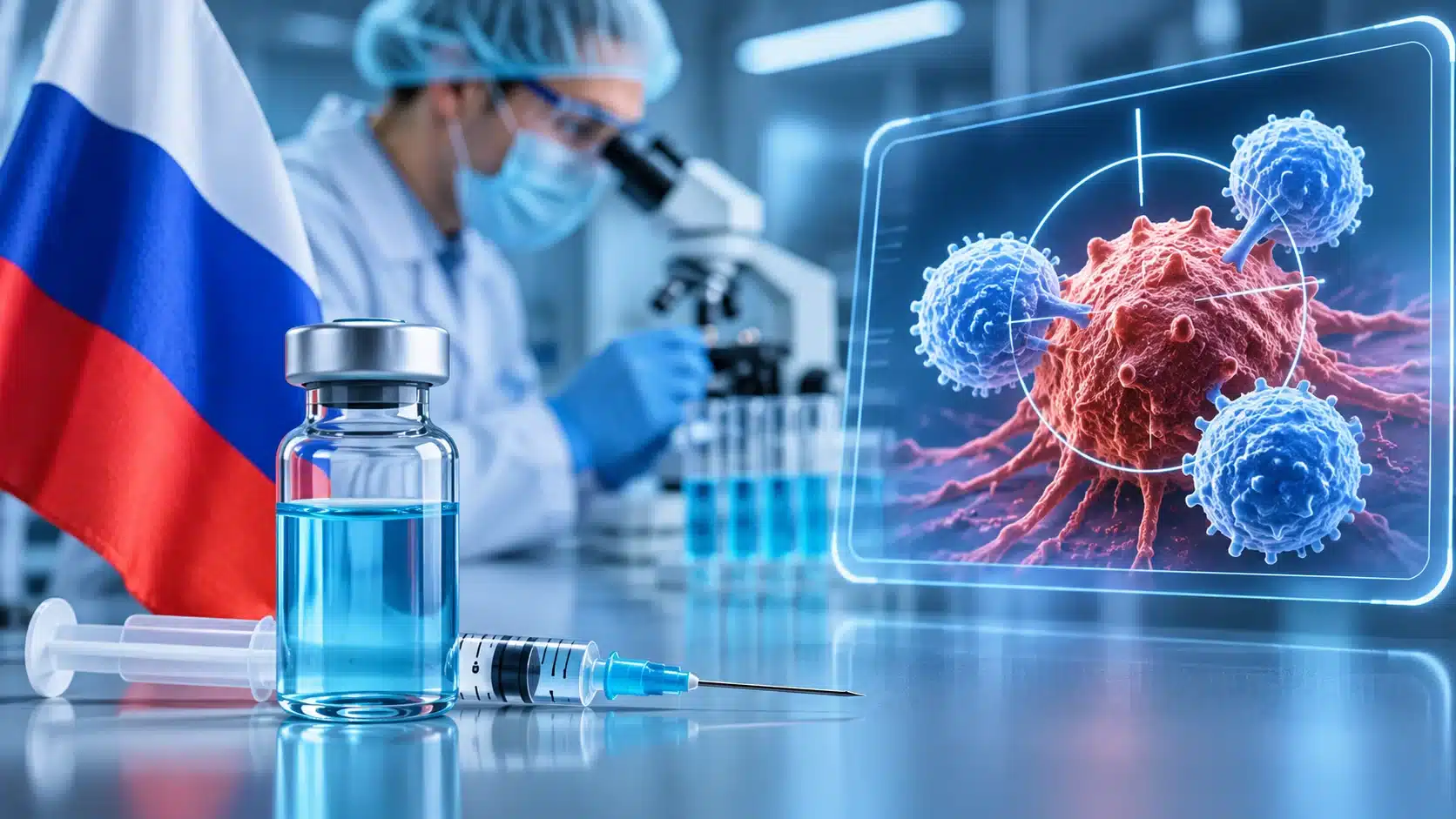
Russian Cancer Vaccine Shows Promising Results in First Melanoma Patient
Russian researchers say the first melanoma patient treated with Neooncovac, a personalized mRNA cancer vaccine, no longer has detectable metastases about four months after finishing treatment. The claim comes from Alexander Gintsburg, scientific director of Moscow’s Gamaleya Center, who developed the vaccine. It is encouraging news, but it describes one patient, comes from the developers themselves, and has not yet appeared in a peer-reviewed journal. This guide explains what was reported, how the Russian cancer vaccine 2026 program works, and what still needs to be proven.
What Happened to the First Patient Treated With Neooncovac?
The first patient is a 60-year-old man from Russia’s Kursk region. He had stage III cutaneous melanoma that had spread to his lymph nodes despite earlier surgeries. He received his first dose in April 2026 at the Herzen Moscow Oncology Research Institute, part of the National Medical Research Radiological Center (NMRRC), and his final dose in early September, according to Gintsburg’s earlier comments.
In July, Gintsburg said the patient felt well and had developed an immune response against the cancer. In September, the team said the course had been completed with good tolerability.
Russian Researchers Report No New Detectable Metastases
In an interview with Gazeta.ru, Gintsburg said recent scans showed no new tumors and that the patient’s earlier metastases were no longer visible. GxP News reported that the patient now has CT scans every month, with particular attention to the lymph nodes, and that follow-up is planned for about three years if his condition stays favorable.
Some outlets described this as “complete remission.” That wording comes from media reports and the developer. No independent imaging review or published response data has been released, so it should be read as a preliminary clinical observation.
Here is what the key terms mean:
- Metastasis: cancer that has spread from its original site to other parts of the body, such as lymph nodes.
- Complete response: all detectable signs of cancer disappear on scans.
- Partial response: tumors shrink by a defined amount, usually at least 30%, but do not disappear.
- Stable disease: tumors neither shrink enough to count as a response nor grow enough to count as progression.
- Progression: tumors grow or new ones appear.
- Remission: a reduction or disappearance of signs of cancer. It can be partial or complete, and it is not the same as a cure.
- Recurrence: cancer returning after a period when it could not be detected.
What Is Neooncovac?
Neooncovac (also written NeoOncovac or Neoonkovak) is a personalized mRNA cancer vaccine. It is not a preventive shot like a flu vaccine. It is a treatment, made separately for each patient from the genetic profile of their own tumor.
The Russian Health Ministry authorized its clinical use at the end of 2025. It is currently intended for adults with inoperable or metastatic skin melanoma, Izvestia reported when the first patient was treated.
How Does Russia’s Personalized mRNA Cancer Vaccine Work?
Cancer cells carry mutations that produce abnormal proteins called neoantigens. Because healthy cells do not make them, they are useful targets for the immune system. The process generally works like this:
- Doctors take a tumor sample and sequence its DNA.
- Software, which Russian officials say is AI-assisted, picks the neoantigens most likely to trigger an immune response.
- Scientists write mRNA instructions for those targets and package them for injection.
- The patient’s cells read the mRNA, make the neoantigen fragments, and “show” them to the immune system, training T cells to hunt down cancer cells carrying the same markers.
This approach is the same basic idea behind personalized mRNA cancer immunotherapy being tested worldwide. The first patient received a course of injections; the second patient is on a 10-injection course.
Who Developed the Russian Cancer Vaccine?
Neooncovac was developed by three state institutions:
- The Gamaleya National Research Center, best known for the Sputnik V COVID-19 vaccine, led by scientific director Alexander Gintsburg and director Denis Logunov.
- The National Medical Research Radiological Center, including the Herzen Institute, headed by Andrey Kaprin, which manufactures the vaccine and treats patients.
- The Blokhin National Medical Research Center of Oncology.
Kaprin has called it a fundamentally new approach that trains the immune system rather than attacking tumors directly.
How Many Patients Have Received the Treatment?
As of mid-November 2026, Gintsburg said six melanoma patients had received the vaccine and four more had begun treatment. The team aims to treat 20 patients by the end of 2026. The Health Ministry has funded treatment and follow-up for 120 patients in 2026–2027.
Only the first patient’s outcome has been described publicly. Results for the others are not yet available.
Vietnamese Oncologist Explains Why the Results Are Encouraging
The news drew comment from oncologists abroad, including Vietnamese physician Dr. Nguyen Duy Anh, whose remarks were reported in Vietnamese media. We could not independently confirm his exact wording, so we summarize only the general reasoning that oncologists commonly give.
Why would experts call this encouraging? Stage III melanoma that keeps spreading after surgery is hard to control. A personalized vaccine that produces a measurable immune response and no visible spread for several months fits what earlier neoantigen studies have suggested. Specialists typically add the same caveats: one case is not proof, longer follow-up is needed, and the vaccine must be tested against standard care in controlled trials.
Does the Russian Cancer Vaccine Cure Cancer?
No. There is no evidence that Neooncovac cures cancer. Four months without visible metastases is a positive early sign, but melanoma can return months or years later. That is why doctors plan three years of monitoring.
It also matters that the patient may have received other therapy. Izvestia reported that the first patient was undergoing immunotherapy at the time, and the developers have not published a full treatment history. Without that, it is impossible to say how much of the result is due to the vaccine alone.
A January 2026 claim that the vaccine was “more than 90% effective” came from the developers before any human results and has not been backed by published data.
Neooncovac vs. Traditional Cancer Treatments
Established melanoma care includes surgery, immune checkpoint inhibitors such as pembrolizumab and nivolumab, targeted drugs for BRAF-mutated tumors, and radiation. These treatments are backed by large randomized trials.
Personalized vaccines are designed to work alongside them, not replace them. The most advanced example, Moderna and Merck’s intismeran autogene (mRNA-4157/V940), was tested with pembrolizumab in the 157-patient KEYNOTE-942 trial. Its Phase 3 trial, INTerpath-001, met its efficacy endpoints in August 2026, and the companies reported a 42% reduction in recurrence or death in October 2026.
Neooncovac has no published comparable trial yet. Patients should not stop or delay proven treatment in hopes of getting an experimental vaccine. You can learn more about managing serious health conditions on our site.
What Are the Possible Side Effects?
The developers say the first patient sometimes had a fever of 38–38.5°C (about 100.4–101.3°F), which went away within hours with standard fever-reducing medicine. The second patient, halfway through treatment, has had no fever, RT reported.
In trials of similar mRNA cancer vaccines, the most common side effects were fatigue, injection-site pain, and chills. Long-term safety data for Neooncovac have not been published.
How Much Does the Russian Cancer Vaccine Cost?
Gintsburg said about 7 million rubles is allocated per patient to make the individual vaccine and deliver the full course. The money flows through Russia’s compulsory medical insurance (OMS) system, so eligible Russian citizens are treated free of charge.
Earlier, in 2025, officials estimated about 300,000 rubles per vaccine. The difference may reflect the full treatment course and monitoring versus one manufactured dose, but this has not been clearly explained.
What Clinical Trials Are Still Needed?
For Neooncovac to be accepted as an effective treatment, researchers will need:
- Publication of patient results in a peer-reviewed journal.
- Registration of a trial with clear endpoints, such as recurrence-free survival.
- Randomized comparison against standard care, ideally with independent review of scans.
- Longer follow-up, measured in years, to track recurrence.
- Full safety reporting across all treated patients.
We found no international trial registry entry or published dataset for Neooncovac as of this writing.
Could Personalized Cancer Vaccines Transform Cancer Treatment?
Possibly. Personalized mRNA vaccines are among the most closely watched areas in oncology. Beyond melanoma, researchers are testing them in pancreatic, lung, kidney, and head and neck cancers. Russia says it plans to expand Neooncovac to other tumor types as well.
The field is promising because it builds on proven immunotherapy and targets each patient’s own tumor. The hurdles are cost, manufacturing speed, and proving benefit in large trials. Healthy habits still matter for cancer prevention; see our guide to preventive health.
Frequently Asked Questions
What is the Russian cancer vaccine Neooncovac?
It is a personalized mRNA vaccine made from each patient’s tumor genetics. It is used to treat advanced skin melanoma in Russia, not to prevent cancer.
Did the first patient’s cancer disappear?
The developers say scans show no new tumors and no detectable metastases about four months after treatment. This has not been independently verified or published.
Is Neooncovac a cure for cancer?
No. It is an experimental treatment with very limited data. Melanoma can recur, so long-term monitoring is required.
How many people have received the Russian cancer vaccine?
Six patients had received it by mid-November 2026, four more had started, and the goal is 20 by the end of the year.
Can foreigners get the Russian cancer vaccine?
Officials have described it as funded for eligible Russian citizens through state insurance. No program for international patients has been announced.
Are there similar cancer vaccines in other countries?
Yes. Moderna and Merck’s intismeran autogene reported positive Phase 3 results in melanoma in 2026, and BioNTech and others are testing personalized vaccines.
Conclusion
Neooncovac’s first reported result is hopeful: a man with spreading stage III melanoma has had no detectable metastases for about four months. But this is one patient, reported by the vaccine’s developers, without published data or independent review. The real test will come from controlled trials and years of follow-up. Anyone with melanoma should keep working with their oncologist on proven treatments and ask about clinical trials that may be available.
Find more evidence-based health guides on Learning Joan.
