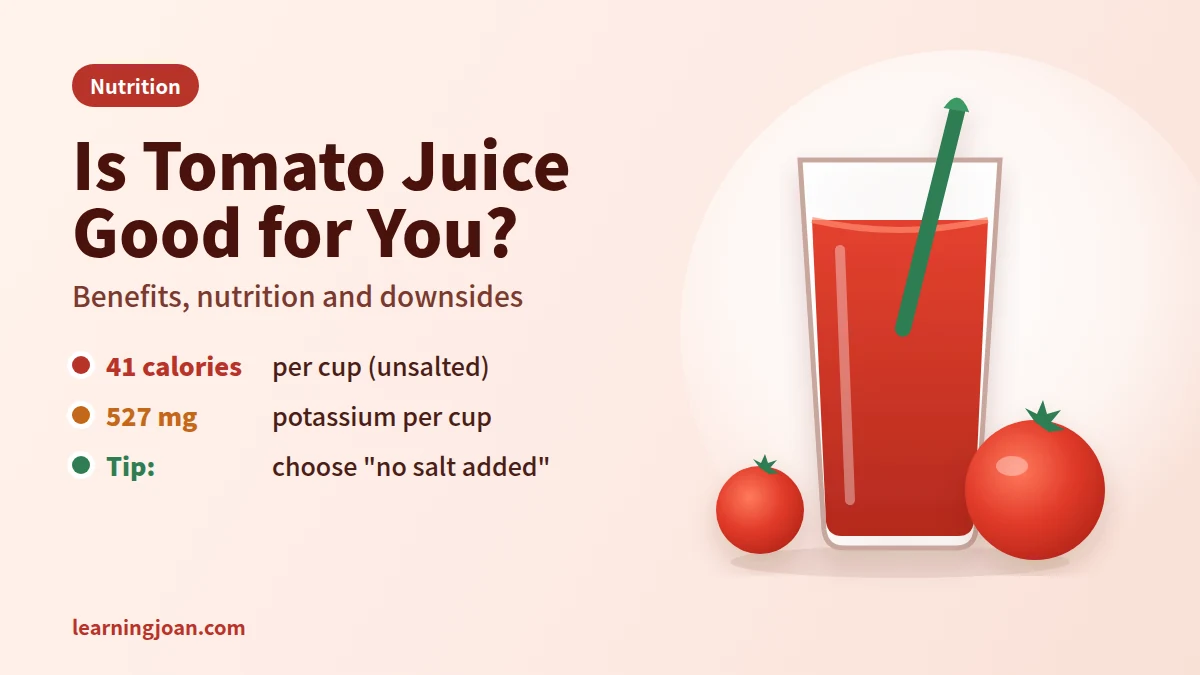
Is Tomato Juice Good for You? Benefits, Nutrition and Downsides
Tomato juice has a reputation as a health drink. So is tomato juice good for you? For most people, yes, with one important condition: pick a version without added salt.
Quick answer: Unsalted tomato juice is low in calories and rich in potassium and lycopene. One cup has about 41 calories, 527 mg of potassium and roughly 22 mg of lycopene, according to USDA FoodData Central. The main downside is sodium: salt is added to some versions, and the amount varies widely by brand.
Here’s what’s in a glass, what the research does and doesn’t show, who should be careful, and how to choose a healthier bottle.
Tomato Juice Nutrition Facts
These figures are for 1 cup (243 g) of canned tomato juice without added salt.
| Nutrient | Amount per cup |
|---|---|
| Calories | 41 |
| Carbohydrates | 8.6 g (of which sugars 6.3 g) |
| Fiber | About 1 g |
| Protein | 2.1 g |
| Potassium | 527 mg (11% of the Daily Value) |
| Sodium | 24 mg |
| Lycopene | About 22 mg |
| Vitamin C | Varies by brand (USDA lists about 170 mg) |
Source: USDA FoodData Central, entry #170545. Vitamin C varies a lot between products, partly because some juices have vitamin C added, so check the label on your bottle.
Benefits of Tomato Juice
It’s a Rich Source of Lycopene
Lycopene is the red pigment in tomatoes and one of the carotenoids researchers study for heart health. Tomato juice is a convenient way to get it: a single cup contains about 22 mg.
How much your body absorbs may matter as much as how much you drink. In a human study published in the British Journal of Nutrition, lycopene from heat-processed tomato sauce was better absorbed. The Ohio State University researchers behind it explained that both heat and some fat play a part. In practice, drinking tomato juice with a meal that contains a little fat may help.
It’s High in Potassium
With 527 mg per cup, unsalted tomato juice provides about 11% of the Daily Value for potassium in a low-calorie drink. That’s one reason it’s often linked with heart health, but it’s also why some people need to limit it (see below).
What the Research Shows on Blood Pressure and Cholesterol
The best-known study followed 481 adults in Japan who drank as much unsalted tomato juice as they wanted for a year. Most drank about 200 ml (a little under a cup) a day. It was published in Food Science & Nutrition in 2019.
| Group | Before | After one year |
|---|---|---|
| 94 people with untreated high or borderline blood pressure | 141.2 / 83.3 mmHg | 137.0 / 80.9 mmHg |
| 125 people with untreated high cholesterol (LDL) | 155.0 mg/dL | 149.9 mg/dL |
These are encouraging but modest changes, and the study had limits. Everyone drank the juice, so there was no comparison group, which means other factors could have played a part. The research was also funded by Kikkoman, the parent company of the juice brand used. Tomato juice isn’t a treatment for high blood pressure or cholesterol, so don’t use it in place of medicine your doctor has prescribed.
It’s Low in Calories
At about 41 calories per cup, unsalted tomato juice is a light option compared with many sweetened drinks. It won’t keep you full for long, though, because it has only about 1 g of fiber per cup.
Tomato Juice vs Whole Tomatoes
Both are good choices, but they’re not the same. Juice gives you lycopene and potassium in a form that’s easy to drink, and processing may make its lycopene easier to absorb. Whole tomatoes keep more of their fiber, so they’re more filling and better for digestion. If you enjoy both, there’s no need to pick one.
Downsides: Who Should Be Careful
People Watching Their Sodium
This is the big one. The unsalted juice in the table above has just 24 mg of sodium per cup, but salted versions can contain far more, and brands differ a lot. The FDA sets the Daily Value for sodium at less than 2,300 mg a day and says a serving with 20% of the Daily Value or more is high in sodium. That’s 460 mg or more per serving.
People With Kidney Disease
The Academy of Nutrition and Dietetics lists tomato juice among higher-potassium foods. If your kidneys aren’t working well, potassium can build up in your blood and affect your heart rhythm. If you have kidney disease, ask your doctor or dietitian whether tomato juice fits your potassium limit.
People With Acid Reflux or Heartburn
Tomato products are a common heartburn trigger. The International Foundation for Gastrointestinal Disorders lists them among foods to reduce if you have GERD, though triggers differ from person to person. If tomato juice gives you heartburn, it’s not for you.
People With Diabetes
A cup of unsalted tomato juice has 8.6 g of carbohydrate, including 6.3 g of natural sugars. That’s modest, but it still counts toward your carbohydrate total. Choose juice with no added sugar, and ask your care team how it fits your meal plan.
How to Choose a Healthier Tomato Juice
The label tells you almost everything. Here’s what the common sodium claims mean, according to the FDA:
| Label says | What it means |
|---|---|
| Sodium-free | Less than 5 mg of sodium per serving |
| Very low sodium | 35 mg or less per serving |
| Low sodium | 140 mg or less per serving |
| Reduced sodium | At least 25% less sodium than the regular product |
| No salt added / unsalted | No salt added during processing, but the product may still contain some sodium |
- Check the milligrams, not just the claim. Look at sodium per serving and the %DV. 5% DV or less counts as low.
- Read the ingredients. Ideally it’s just tomatoes, perhaps with added vitamin C.
- Watch the serving size. Bottles often contain more than one serving.
- Be careful with blends. Vegetable juice blends and cocktail mixes can have different sodium and sugar levels.
How Much Tomato Juice Is Reasonable?
There’s no official daily amount. In the Japanese study, most people drank about 200 ml a day. If you drink it regularly, choose an unsalted version, and remember it adds to your daily potassium and, for salted juice, sodium.
Frequently Asked Questions
Is it good to drink tomato juice every day?
For most healthy adults, a glass of unsalted tomato juice a day can fit into a balanced diet. People with kidney disease, frequent heartburn, or a doctor-advised sodium or potassium limit should check with their care team first.
Does tomato juice lower blood pressure?
One year-long study in Japan found small drops in blood pressure among people with untreated high or borderline blood pressure who drank unsalted tomato juice. It had no comparison group, so the evidence is limited, and tomato juice shouldn’t replace prescribed treatment.
Is tomato juice good for weight loss?
It’s low in calories, about 41 per cup, so it can replace higher-calorie drinks. But it has little fiber, so it won’t keep you full, and no single drink causes weight loss.
Is tomato juice good for diabetics?
Unsweetened tomato juice is relatively low in carbohydrate, with about 8.6 g per cup. Count it in your carbohydrate total, avoid versions with added sugar, and ask your care team how it fits your plan.
What’s the difference between “low sodium” and “no salt added”?
“Low sodium” means 140 mg or less per serving. “No salt added” means no salt was added during processing, but the juice may still contain some natural sodium, so check the milligrams on the label.
Is canned tomato juice as healthy as fresh?
It can be. Heat processing may make lycopene easier to absorb, while vitamin C varies by product. The bigger difference is usually salt, so compare labels.
The Bottom Line
Tomato juice can be a healthy, low-calorie drink that provides potassium and lycopene. Choose an unsalted or low-sodium version, drink it alongside a balanced diet, and skip it or check with your doctor if you have kidney disease, a potassium or sodium limit, or tomato-triggered heartburn.
Sources
- Tomato juice, canned, without salt added (#170545), USDA FoodData Central
- Unsalted tomato juice intake improves blood pressure and serum LDL cholesterol level in local Japanese residents at risk of cardiovascular disease, Odai et al., Food Science & Nutrition, 2019
- Report on the study’s funding, NutraIngredients, 2019
- Lycopene from heat-induced cis-isomer-rich tomato sauce is more bioavailable than from all-trans-rich tomato sauce in human subjects, British Journal of Nutrition, 2007
- Turning up the heat on tomatoes boosts absorption of lycopene, The Ohio State University (via ScienceDaily)
- Sodium in Your Diet, U.S. Food and Drug Administration
- Kidney Disease: High and Moderate Potassium Foods, Academy of Nutrition and Dietetics
- Diet Changes for GERD, International Foundation for Gastrointestinal Disorders
Sources accessed September 28, 2026. This article is general information and isn’t a substitute for advice from your doctor or a registered dietitian.
