
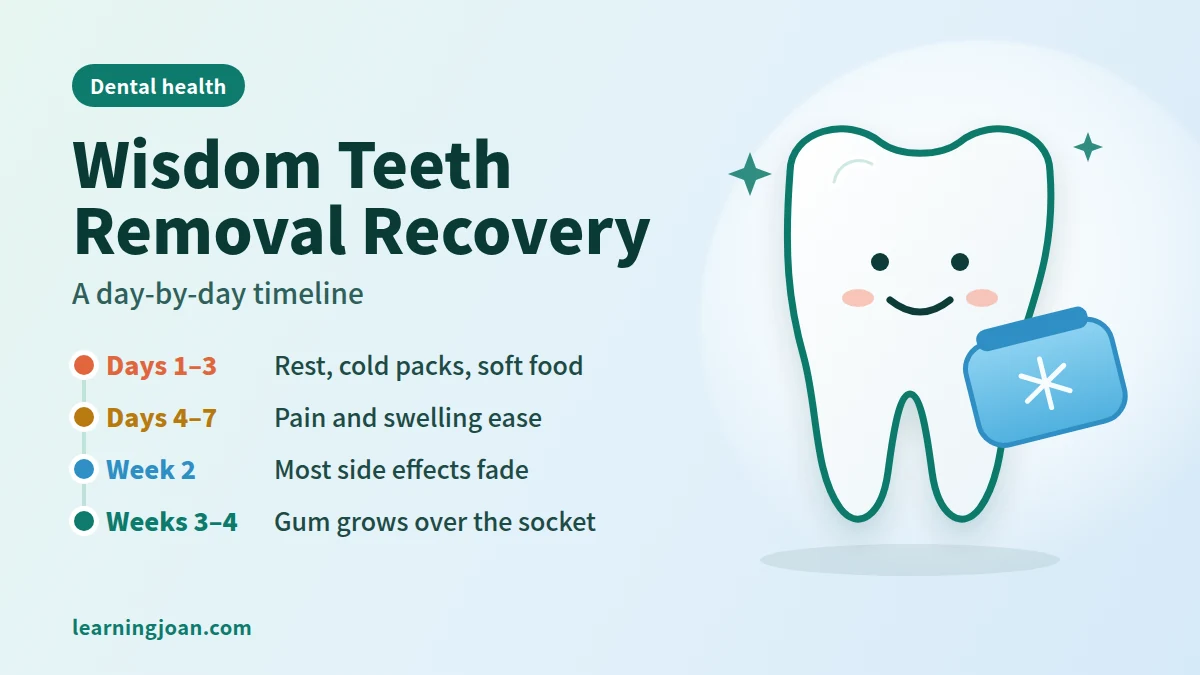
Wisdom Teeth Removal Recovery: Day-by-Day Timeline and Tips
Getting your wisdom teeth out is quick. The recovery is what people plan around: how swollen you’ll be, when you can eat normally, and how to avoid the dreaded dry socket.
Quick answer: Bleeding, pain and swelling usually ease within about a week, and most people are back to their daily routine by around day 5, according to Cleveland Clinic. The NHS says full recovery can take up to 2 weeks, and the socket itself can take a month or more to fill in with new gum.
Below is a day-by-day timeline, what to eat, how to protect the healing socket, and the signs that mean you should call your dentist or oral surgeon.
Wisdom Teeth Recovery Timeline at a Glance
| When | What’s normal | What helps |
|---|---|---|
| First 24 hours | Oozing blood, numbness wearing off, swelling starting | Gauze, rest with your head raised, cold packs, no rinsing, spitting or straws |
| Days 1 to 3 | Light bleeding, swelling and pain at their worst; sore, stiff jaw | Soft foods, pain relief as advised, cold compresses |
| Days 4 to 7 | Pain, swelling and bleeding easing; most people back to their routine by about day 5 | Gentle salt-water rinses when your surgeon says so, light activity only |
| Week 2 | Side effects mostly gone; jaw stiffness and bruising fading | Add more foods (nothing crunchy or chewy yet), follow-up visit |
| Weeks 3 to 4 | New gum growing over the socket | Gentle brushing over the area, back to normal foods and exercise |
Based on Cleveland Clinic and NHS guidance. Your surgeon’s instructions for your case come first.
The First 24 Hours
The first day is about letting a blood clot form in each socket. That clot protects the bone and nerves underneath while the area heals.
- Bleeding: keep the gauze in place for about 30 minutes, then replace it if needed. Some oozing is normal. If it bleeds, press on the area with clean gauze for at least 10 minutes.
- Swelling: hold a cold pack wrapped in a towel against your cheek for 20 minutes, then take it off for 20 minutes, and repeat.
- Rest: sleep with an extra pillow so your head stays raised.
- Protect the clot: for 24 hours, don’t rinse, spit or have hot drinks, and don’t use a straw.
- Pain relief: take what your surgeon prescribed or recommended. The NHS suggests paracetamol (acetaminophen) or ibuprofen, and Cleveland Clinic advises avoiding aspirin, which can make the socket bleed more. Check with a pharmacist if you take other medicines.
If you had a sedative, don’t drive for at least 24 hours. After a general anesthetic, the NHS says to wait 48 hours. Arrange a ride home in advance.
Days 1 to 3: The Toughest Stretch
Expect some light bleeding, swelling and pain. Swelling usually peaks in the first few days and then slowly goes down. Opening your mouth may feel sore and stiff for a few days, which is one more reason to stick to soft food.
Drink plenty of water, but don’t swish it around your mouth. Keep using cold compresses and keep your head raised when you rest.
Days 4 to 7: Turning the Corner
Pain, swelling and bleeding should be noticeably better. Cleveland Clinic says most people return to their daily routine by about day 5, and Guy’s and St Thomas’ NHS Trust puts the average recovery at 3 to 7 days.
This is also when rinsing comes back in. The advice on timing varies: the NHS says gentle rinsing with antiseptic mouthwash or warm salt water can start after 24 hours, while Cleveland Clinic’s timeline starts warm salt-water rinses around days 4 to 7. Follow your own surgeon’s instructions, and rinse gently rather than swishing hard.
Light activities are fine, but avoid anything that gets your heart rate up, as it can bring back bleeding, swelling and pain.
Week 2 and Beyond
By week 2, most side effects have faded, though the gums still need care. The NHS says a stiff, sore jaw should wear off within 7 to 10 days, and any bruising on your cheek can last up to 2 weeks.
- Keep up salt-water rinses and brush and floss your other teeth, avoiding the socket.
- Add new foods, as long as they aren’t crunchy or chewy.
- Go to your follow-up appointment, and mention any ongoing pain, especially facial pain.
In weeks 3 and 4, new gum tissue grows over the socket. You can gently brush the area, go back to your usual foods, and return to more intense exercise.
How to Prevent Dry Socket
Dry socket happens when the blood clot in the socket doesn’t form properly, or comes loose too early and leaves bone exposed. It’s painful and slows healing. According to Cleveland Clinic, it affects about 2% to 5% of tooth extractions and is more common after wisdom teeth removal.
Most of the prevention is about not disturbing the clot:
- Don’t drink through a straw.
- Don’t smoke. The NHS notes smoking also raises the risk of infection.
- Don’t rinse, spit or swish for the first 24 hours, and rinse gently after that.
- Skip fizzy drinks and alcohol for at least five days.
- Eat soft food and chew with your other teeth.
Dry Socket or Normal Healing?
| Normal healing | Possible dry socket |
|---|---|
| Pain eases a little each day | Pain gets better, then suddenly gets much worse, and may spread toward the ear |
| A dark blood clot sits in the socket | The socket looks empty, sometimes with a whitish layer or visible bone |
| Mild, fading discomfort | A bad taste or bad breath that doesn’t go away |
If you think you have a dry socket, contact your dentist. They can clean out the socket and place a medicated dressing, according to Ireland’s HSE. Cleveland Clinic says a dry socket usually heals within a week.
What Can You Eat After Wisdom Teeth Removal?
Stick to soft or liquid food for the first few days and chew with your other teeth. Avoid hard, crunchy or chewy foods, and foods like nuts and seeds that can get stuck in the socket. Skip hot drinks for the first 24 hours.
| Stage | Examples |
|---|---|
| Days 1 to 3 | Yogurt, smoothies (eaten with a spoon), applesauce, lukewarm soup, mashed potatoes |
| Days 4 to 7 | Scrambled eggs, soft pasta, oatmeal, soft fish |
| Week 2 | More variety, but still nothing crunchy or chewy |
| Weeks 3 to 4 | Your usual foods, including crunchy and chewy ones, once the socket has closed over |
When Can You Brush, Exercise, Work and More?
| Activity | General guidance |
|---|---|
| Brush your teeth | Brush and floss your other teeth every day from the start, avoiding the sockets. Gently brush the new gum over the socket from about weeks 3 to 4. |
| Rinse | Not for the first 24 hours. After that, rinse gently when your surgeon advises. |
| Drink alcohol or fizzy drinks | Skip them for at least five days. |
| Exercise | Cleveland Clinic says most people can resume their fitness routine in about 48 to 72 hours, once their surgeon says it’s OK. Avoid heavy lifting until then. |
| Go back to work or school | Plan to stay home for at least three to five days. Physically demanding jobs may need longer. |
| Drive | Not for at least 24 hours after a sedative, or 48 hours after a general anesthetic. |
When to Call Your Dentist or Oral Surgeon
Most recoveries go smoothly. Cleveland Clinic advises calling your provider if you have:
- Swelling that gets worse after three days
- A fever higher than 102°F (38.8°C)
- Pus coming from the socket or incision
- Bleeding that doesn’t stop
- Severe pain that doesn’t improve with medication
The NHS also recommends getting an urgent dental appointment if you have pain with a bad taste in your mouth, a high temperature or feel unwell. Numbness or tingling in your tongue, lip or chin that doesn’t fade is uncommon, but tell your surgeon about it.
Get emergency help right away if you have difficulty breathing or swallowing.
Frequently Asked Questions
How long does wisdom teeth removal recovery take?
Bleeding, pain and swelling usually ease within about a week, and most people are back to their routine by about day 5. Full recovery can take up to 2 weeks, and the socket takes several more weeks to fill in completely.
When can I eat solid food after wisdom teeth removal?
Start with soft food for the first few days. In week 2 you can add more foods as long as they aren’t crunchy or chewy, and most people return to their usual foods in weeks 3 to 4.
When can I stop worrying about dry socket?
The risk is highest in the first days after surgery, while the clot is fragile, and it falls as the socket heals. Once the wound has fully healed, dry socket can’t happen, as Medical News Today explains. Keep protecting the clot until your surgeon says it’s healed.
Is swelling worse on day 2 or day 3?
Swelling is usually worst in the first few days and then gradually improves. Swelling that is getting worse after day 3 is a reason to call your surgeon.
Can I drink through a straw after wisdom teeth removal?
No. Sucking through a straw can pull the blood clot out of the socket and cause a dry socket. Drink from a cup and eat smoothies with a spoon until your surgeon says the socket has healed.
Do wisdom teeth need to be replaced after removal?
Usually not. Cleveland Clinic describes wisdom teeth as vestigial, meaning we no longer need them to chew. If you lose a different tooth, a dental implant is one way to replace it.
The Bottom Line
Expect the first three days to be the hardest, a big improvement by the end of the first week, and most side effects gone within two weeks. Protect the blood clot, eat soft food, and call your surgeon if pain or swelling gets worse instead of better.
Sources
- Wisdom Teeth Removal, Cleveland Clinic (medically reviewed August 2026)
- Dry Socket, Cleveland Clinic
- Wisdom tooth removal: recovery, NHS
- Wisdom tooth removal: what happens, NHS
- Recovering from wisdom tooth surgery, Guy’s and St Thomas’ NHS Foundation Trust
- Wisdom tooth removal: recovery, HSE (Ireland)
- Dry socket vs normal socket, Medical News Today
Sources accessed September 28, 2026. This article is general information and isn’t a substitute for advice from your dentist or oral surgeon.
