
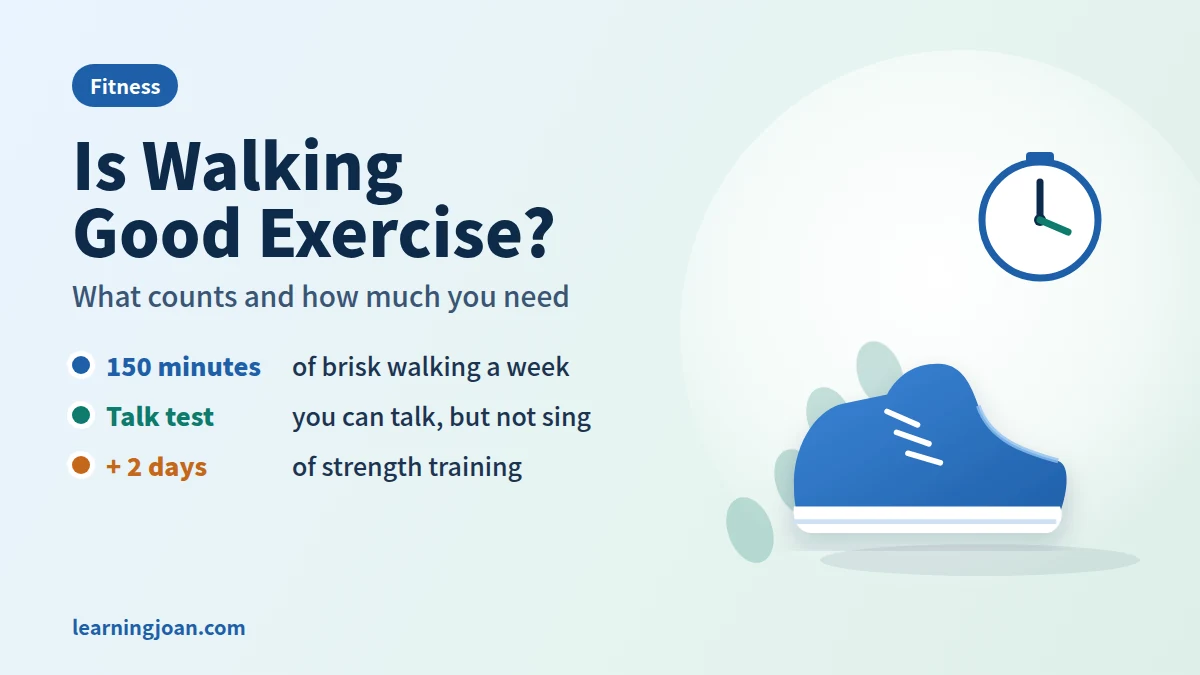
Is Walking Good Exercise? What Counts and How Much You Need
Walking doesn’t look like much of a workout, so it’s fair to ask: is walking good exercise? Yes, as long as it’s brisk enough and you do enough of it. It’s also one of the easiest ways to meet the official activity guidelines.
Quick answer: Brisk walking counts as moderate-intensity aerobic exercise. The CDC recommends at least 150 minutes a week of it (for example, 30 minutes a day, 5 days a week), plus muscle-strengthening activities on at least 2 days a week. Walking covers the first part. It doesn’t replace the second.
What Counts as Brisk Walking?
A slow stroll is still better than sitting, but “brisk” is what makes walking count as moderate exercise. The CDC describes brisk walking as 2.5 miles per hour or faster. You don’t need a speedometer, though. Two simple checks work just as well:
- The talk test: at a moderate pace, you can talk but not sing. If you can only say a few words before pausing for breath, you’ve moved into vigorous intensity.
- The effort scale: on a scale where 0 is sitting and 10 is your hardest effort, moderate activity feels like a 5 or 6. Vigorous starts at about 7 or 8.
| How it feels | Intensity | Counts toward the 150 minutes? |
|---|---|---|
| Easy stroll; you could sing | Light | Not on its own, but it’s still better than sitting |
| Brisk pace; you can talk but not sing (effort 5–6) | Moderate | Yes, minute for minute |
| Very fast or uphill; only a few words at a time (effort 7–8) | Vigorous | Yes, and each minute counts about double |
Because intensity is relative, the same speed can feel moderate to one person and vigorous to another. Go by the talk test rather than someone else’s pace.
How Much Walking Do You Need?
For adults, the CDC’s weekly targets are:
- Aerobic activity: at least 150 minutes of moderate activity such as brisk walking, or 75 minutes of vigorous activity, or a mix. As a rule of thumb, 1 minute of vigorous activity is about the same as 2 minutes of moderate.
- Muscle strengthening: at least 2 days a week of activities that work all major muscle groups.
- For adults 65 and older: the same, plus activities that improve balance.
| Ways to reach 150 minutes of brisk walking | Weekly total |
|---|---|
| 30 minutes, 5 days a week | 150 minutes |
| About 22 minutes, every day | 154 minutes |
| 50 minutes, 3 days a week | 150 minutes |
If 150 minutes sounds like a lot, start smaller. The CDC notes that adults who sit less and do any amount of moderate-to-vigorous activity gain some health benefits, and that benefits begin even below 150 minutes a week. Doing more than 150 minutes brings further benefits.
Health Benefits of Walking
Brisk walking is moderate-intensity activity, so it delivers the benefits the CDC links to regular physical activity:
| When | Benefits |
|---|---|
| Right after a session | Better sleep quality, less anxiety, lower blood pressure |
| With regular activity over time | Lower risk of heart disease, stroke and type 2 diabetes; lower risk of dementia and depression; lower risk of 8 cancers (bladder, breast, colon, endometrium, esophagus, kidney, lung and stomach); less weight gain; better bone health; fewer falls |
The CDC also notes that regular activity can lower blood pressure and improve cholesterol levels, and that combining it with healthy eating helps you reach and keep a healthy weight.
Is Walking Cardio?
Yes. Walking is aerobic (“cardio”) activity: it uses large muscles in a steady rhythm and raises your heart rate and breathing. At a brisk pace, it’s the CDC’s go-to example of moderate-intensity aerobic activity, so it counts toward the weekly 150 minutes.
Does Walking Build Muscle?
Walking works your leg and hip muscles, but it isn’t a substitute for strength training. The CDC recommends separate muscle-strengthening activities on at least 2 days a week, working all major muscle groups: legs, hips, back, abdomen, chest, shoulders and arms. Do each exercise until it’s hard to do another repetition without help.
Options include lifting weights, resistance bands, or bodyweight moves such as squats and push-ups. You can do them on your walking days or on different days.
Walking vs Running
Both count. Running is usually vigorous, so each minute counts about twice as much as a minute of brisk walking: 75 minutes of running a week meets the same guideline as 150 minutes of brisk walking. If running doesn’t suit you, walking gets you to the same target. It just takes more time. The best choice is the one you’ll keep doing.
How to Get More From Your Walks
- Pick up the pace until you pass the talk test: talking is possible, singing isn’t.
- Add hills or stairs. Walking uphill takes more effort and can push you into vigorous intensity.
- Split it up. Several shorter brisk walks through the day still add to your weekly total.
- Track your minutes with a phone or watch, so you know when you’ve reached 150.
- Pair it with strength work on 2 days a week, and add balance exercises if you’re 65 or older.
- If pain holds you back, deal with it rather than pushing through. Our look at whether chiropractic care can help you stay active covers one option people ask about.
When to Check With a Doctor First
Moderate activity like brisk walking is safe for most people. If you’ve been inactive, have a heart condition, diabetes or another chronic condition, or have concerns, talk to your doctor before stepping up to more vigorous exercise. If a health condition makes the full 150 minutes hard, do as much as you comfortably can. Stop and seek medical help if you get chest pain, severe shortness of breath or dizziness while walking.
Frequently Asked Questions
Is walking 30 minutes a day enough exercise?
Brisk walking for 30 minutes on 5 days a week meets the CDC’s 150-minute aerobic guideline. For the full recommendation, add muscle-strengthening activities on at least 2 days a week.
How fast is brisk walking?
The CDC describes brisk walking as 2.5 miles per hour or faster. An easier check is the talk test: you can talk, but you can’t sing.
Is walking cardio?
Yes. Brisk walking is moderate-intensity aerobic activity and counts toward the weekly 150-minute target.
Does walking build muscle?
It works your legs and hips, but it doesn’t replace strength training. The CDC recommends muscle-strengthening activities for all major muscle groups on at least 2 days a week.
Is walking better than running?
Neither is “better” for meeting the guidelines. Running is usually vigorous, so it takes about half the time: 75 minutes versus 150 minutes of brisk walking. Choose the one you’ll stick with.
Can I split my walking into shorter walks?
Yes. What matters is your weekly total of moderate-intensity minutes, and the CDC notes that any amount of moderate-to-vigorous activity brings some benefit.
The Bottom Line: Is Walking Good Exercise?
Walking is good exercise when it’s brisk: fast enough that you can talk but not sing. Aim for 150 minutes a week, such as 30 minutes on 5 days, and add strength training on 2 days. If you’re starting from zero, any brisk walking is a step in the right direction.
Sources
- What You Can Do to Meet Physical Activity Recommendations, Centers for Disease Control and Prevention (CDC)
- How to Measure Physical Activity Intensity, CDC
- Health Benefits of Physical Activity for Adults, CDC
- Benefits of Physical Activity, CDC
- Older Adult Activity: An Overview, CDC
Sources accessed September 29, 2026. This article is general information and isn’t a substitute for advice from your doctor.