
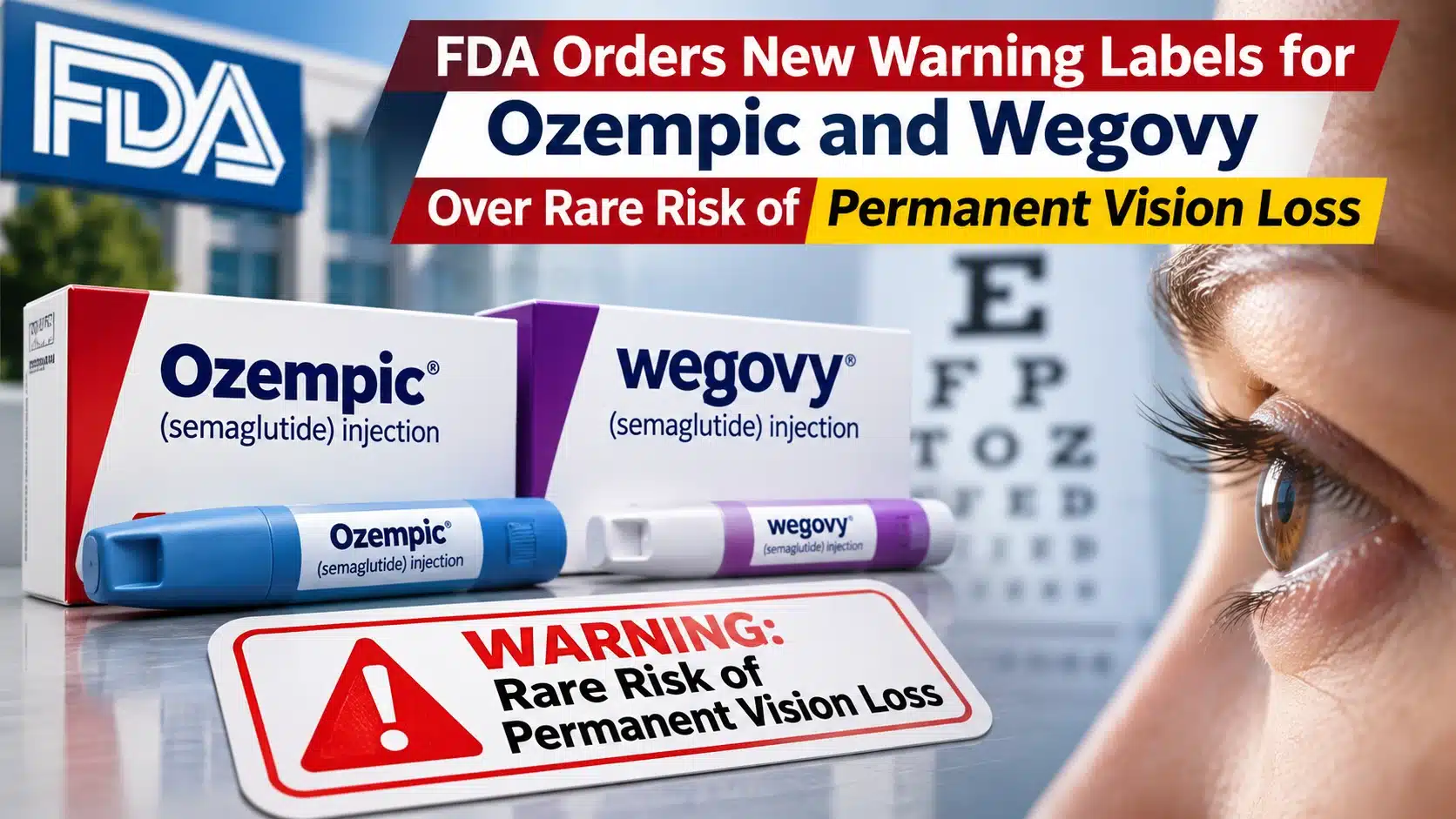
FDA Orders New Warning Labels for Ozempic and Wegovy Over Rare Risk of Permanent Vision Loss
Published November 10, 2026
The Food and Drug Administration has ordered the makers of Ozempic, Wegovy and every other GLP-1 medication to add a new safety warning to their labels. The warning covers non-arteritic anterior ischemic optic neuropathy (NAION), a rare eye condition that can permanently take away part of a person’s sight. The agency announced the change on November 9, 2026. The FDA warning about Ozempic, Wegovy and vision loss reaches far beyond those two brands: it also applies to Mounjaro, Zepbound and roughly a dozen other GLP-1 drugs taken as injections or pills.
The FDA described the risk as “potential.” It stopped short of saying the medicines cause the condition. But because these drugs are now among the most widely prescribed in the country, the agency wants patients and doctors to recognize the warning signs early.
What the FDA Announced
In a Drug Safety Communication, the FDA said it is requiring all GLP-1 manufacturers to add information about NAION to the “Warnings and Precautions” section of their prescribing labels. The agency said NAION cases have been reported with every GLP-1 product currently sold in the United States.
The FDA also gave clinicians specific instructions:
- Tell patients about the potential risk and ask them to report sudden vision changes right away.
- Refer patients with suspected NAION promptly to an ophthalmologist.
- Consider stopping the GLP-1 drug in patients who develop NAION, unless the benefits clearly outweigh the risk.
What Is NAION?
The optic nerve carries images from the eye to the brain. NAION happens when blood flow to the front part of that nerve suddenly drops. Deprived of oxygen, the nerve swells and some of its fibers stop working. Doctors sometimes call it an “eye stroke.”
Most people notice it as sudden, painless blurring or dimming in one eye, often first thing in the morning. Because damaged nerve fibers don’t regrow, the vision loss is frequently permanent. Some patients regain a portion of their sight over the following months, but gaps in the visual field often remain, and no treatment has been proven to reverse the damage.
NAION is uncommon. The FDA says it affects roughly 2 to 10 out of every 100,000 adults over age 50 each year. It has drawn attention now because GLP-1 drugs are so widely used, so even a small change in risk could affect a meaningful number of people.
Which Medications Are Affected?
The FDA warning applies to the entire GLP-1 receptor agonist class, including:
- Ozempic and Rybelsus (semaglutide), approved for type 2 diabetes. Ozempic is also approved to lower heart and kidney risks in certain patients.
- Wegovy (semaglutide), approved for chronic weight management and to reduce cardiovascular risk in some adults.
- Mounjaro (tirzepatide), approved for type 2 diabetes.
- Zepbound (tirzepatide), approved for chronic weight management and obstructive sleep apnea in adults with obesity.
- Trulicity, Victoza, Saxenda, Xultophy, Soliqua, Foundayo and generic exenatide.
Many of these medicines are used mainly for diabetes rather than weight loss. Tirzepatide works on two hormone receptors, GIP and GLP-1, but it falls under the warning because of its GLP-1 activity.
The Research Behind the Warning
Where the concern started
The question gained traction in 2024, when researchers at Massachusetts Eye and Ear published a study in JAMA Ophthalmology. It found that patients prescribed semaglutide had higher rates of NAION than comparable patients on other medicines. The FDA said that study had “several limitations,” but it was enough to prompt a broader review.
The FDA’s clinical trial analysis
The agency pooled data from 126 randomized controlled trials involving 134,253 participants. About 78,000 of them took a GLP-1 drug, and the rest received a placebo or another diabetes medicine. The results:
- GLP-1 users: 6.4 NAION cases per 100,000 person-years
- Comparison groups: 3.8 cases per 100,000 person-years
A person-year is one person followed for one year. Put simply, among 100,000 people taking a GLP-1 drug for a year, researchers would expect about six cases. A similar group not taking one would have about four. The trials recorded only 15 probable cases in total, 10 of them among GLP-1 users. Numbers that small leave real uncertainty about the true size of any added risk.
Real-world data and other studies
The FDA also examined insurance and health records through its Sentinel system. Among adults with type 2 diabetes, GLP-1 users had a higher rate of NAION than people taking DPP-4 inhibitors. The difference compared with SGLT-2 inhibitors was not statistically significant. The agency said stronger published observational studies generally pointed toward higher risk with GLP-1 drugs. Animal studies did not reveal how the drugs might cause the condition.
Signal, not proof
Taken together, the evidence shows a possible link, not an established cause. Many people taking GLP-1 drugs also have diabetes, high blood pressure or sleep apnea, which are themselves risk factors for NAION. Separating the effect of the drug from the effect of these conditions is difficult. Researchers say studies designed specifically to measure eye outcomes, by drug and by dose, are still needed.
How the Drugmakers Responded
Novo Nordisk, which makes Ozempic, Wegovy and Rybelsus, told ABC News that the available data do not establish a cause-and-effect relationship. The company said it remains confident in the benefit-risk profile of its GLP-1 medicines.
Eli Lilly, which makes Mounjaro and Zepbound, told CNN that the FDA’s communication applies to all medicines with GLP-1 activity and does not reference findings specific to Lilly products. The company said it is evaluating the update and will respond to the agency promptly.
Both companies are defending lawsuits from patients who allege vision loss, so their statements reflect their own positions rather than independent scientific review.
NAION Symptoms Patients Should Know
The FDA advises anyone taking a GLP-1 medicine to contact a healthcare professional right away if they notice:
- Sudden, painless vision loss or dimming in one eye, often noticed on waking
- Blurry or hazy vision, especially in the center
- Blind spots or tunnel vision
- Colors that look faded or distorted
- Reduced sharpness in central vision
Prompt care matters. An eye exam can confirm NAION and rule out other urgent problems, such as retinal detachment or stroke, that need different treatment.
Patients should not stop their medication on their own. Stopping suddenly can cause blood sugar to rise or weight to return, and it can remove heart and kidney benefits some people depend on. Any decision about continuing treatment should be made with the prescribing doctor. Keeping diabetes and blood pressure under control and attending regular checkups also support overall eye health. Our guide to normal A1C levels explains one key number to track.
What Happens Next
For patients
Nothing changes about how GLP-1 drugs are prescribed today. Patients will see the new warning in updated medication guides and labels, and they may hear about it at their next appointment.
For healthcare professionals
Doctors and pharmacists are expected to counsel patients about vision symptoms and pay closer attention to people with existing NAION risk factors or a history of the condition, since it can recur in the other eye.
For manufacturers
Companies must submit revised labeling to the FDA. The FDA has not said publicly when the updated labels must be completed.
For research and safety monitoring
The review shows how post-marketing surveillance can surface rare risks that clinical trials are too small to detect. Researchers expect more studies on whether the risk differs between drugs, doses and patient groups. Patients and clinicians can report suspected side effects through the FDA’s MedWatch program online or at 1-800-332-1088.
The Bottom Line
The FDA’s new warning means Ozempic, Wegovy, Mounjaro, Zepbound and other GLP-1 drugs will now carry information about a rare but potentially permanent form of vision loss. The evidence suggests a small possible increase in risk and does not prove the drugs cause it. For most patients, the practical message is to keep taking medication as prescribed, learn the symptoms, and seek care immediately if vision suddenly changes.
Find more evidence-based health guides on Learning Joan.
This article is for general information only and is not a substitute for professional medical advice. Do not stop or change any prescribed medication without talking to your healthcare provider.