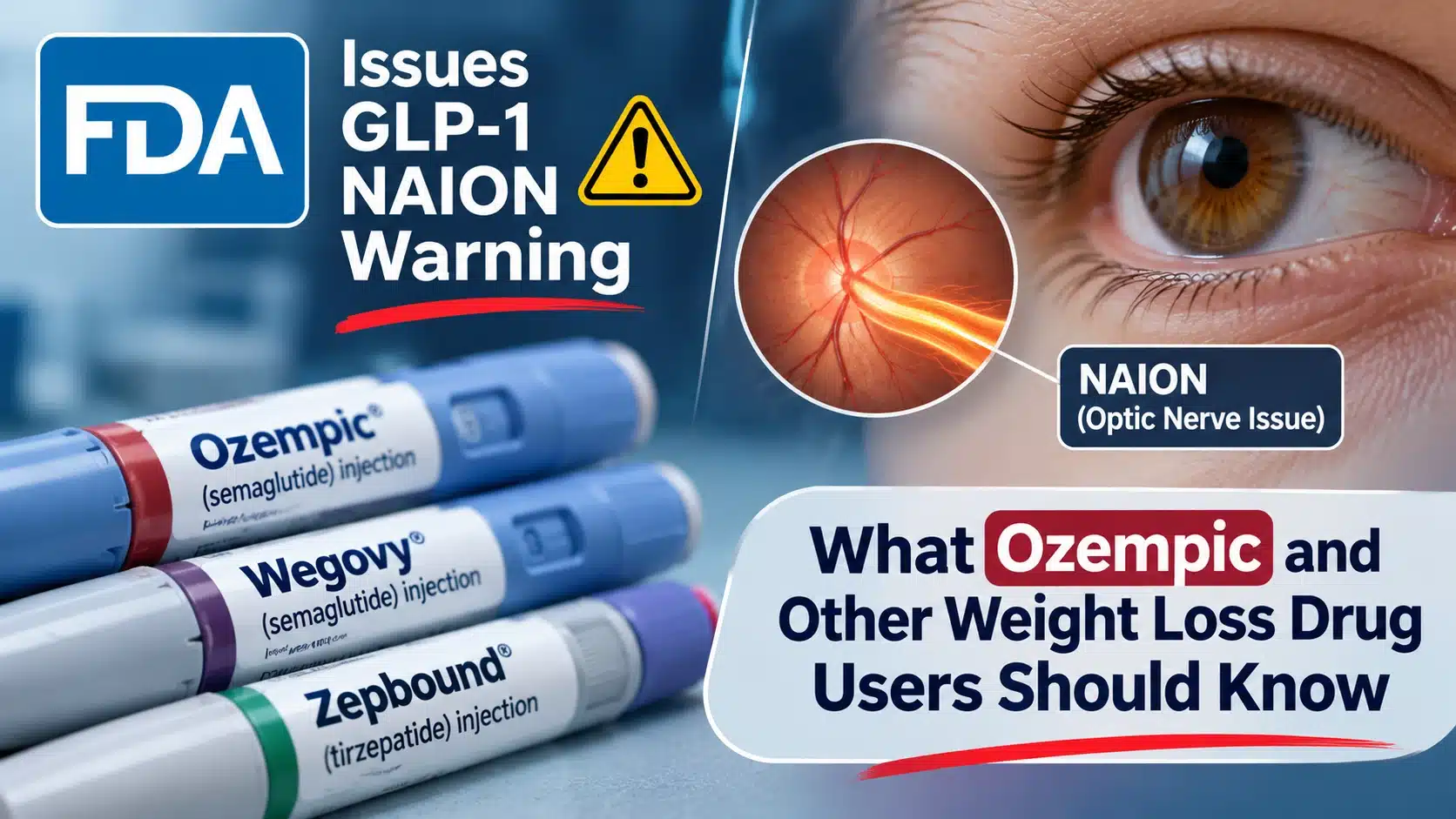
FDA Issues GLP-1 NAION Warning: What Ozempic and Other Weight Loss Drug Users Should Know
Published November 10, 2026
On November 9, 2026, the Food and Drug Administration issued its GLP-1 NAION warning. The FDA now requires every GLP-1 medication, including Ozempic, Wegovy, Mounjaro and Zepbound, to carry label information about a potential increased risk of NAION, a rare condition that damages the optic nerve and can cause sudden vision loss. The FDA calls the risk “potential,” and NAION remains uncommon. Still, anyone taking these drugs should know what the GLP-1 NAION warning from the FDA says and what to do if their vision changes.
The FDA’s GLP-1 NAION Warning at a Glance
- What changed: The FDA’s Drug Safety Communication requires all GLP-1 drug labels to add NAION to the “Warnings and Precautions” section.
- Why: A review of clinical trials, real-world data and published studies found signs of a possible increased risk.
- Which drugs: All marketed GLP-1 medicines. NAION cases have been reported with every one of them.
- What patients should do: Keep taking medication as prescribed, but seek care right away for any sudden vision change.
What Is NAION? Understanding Anterior Ischemic Optic Neuropathy
Your optic nerve works like a cable, carrying visual information from the eye to the brain. Non-arteritic anterior ischemic optic neuropathy, usually shortened to NAION, happens when blood flow to the front of that nerve drops suddenly. “Ischemic” means a lack of blood supply. “Anterior” refers to the front part of the nerve. “Non-arteritic” means the cause isn’t inflamed arteries, which sets it apart from a related condition called giant cell arteritis.
Without enough oxygen, nerve fibers swell and can die. That’s why many doctors describe anterior ischemic optic neuropathy as an “eye stroke.” The typical result is sudden, painless loss of vision in one eye, often discovered on waking. Some people regain a little sight, but many are left with permanent gaps in their vision, and no treatment has been proven to restore it.
Early evaluation still matters. Sudden vision loss can also come from retinal detachment, a brain stroke or giant cell arteritis, and some of those conditions need emergency treatment.
What Are GLP-1 Medications and How Do They Work?
GLP-1 receptor agonists (often written as GLP1 or GLP-1) copy a natural gut hormone called glucagon-like peptide-1. They:
- Prompt the pancreas to release insulin when blood sugar rises, improving blood glucose control
- Slow digestion, so you feel full sooner and longer
- Act on appetite centers in the brain, curbing hunger and supporting weight management
They’re used to treat type 2 diabetes (see our guide to normal A1C levels) and chronic weight management. Depending on the specific drug, other FDA-approved uses include reducing heart attack and stroke risk, slowing kidney disease, treating obstructive sleep apnea in adults with obesity, and treating the liver condition MASH.
Semaglutide vs. tirzepatide
- Semaglutide (Ozempic, Wegovy, Rybelsus) acts only on GLP-1 receptors. It was the drug studied in the 2024 research that first raised NAION concerns.
- Tirzepatide (Mounjaro, Zepbound) acts on both GIP and GLP-1 receptors, which is why it’s called a dual agonist. Because of its GLP-1 activity, it’s included in the FDA’s class-wide warning.
Why Has the FDA Issued a GLP-1 NAION Warning?
The review began after a 2024 study in JAMA Ophthalmology by researchers at Massachusetts Eye and Ear. It reported more NAION among patients prescribed semaglutide than among similar patients on other drugs. The FDA said the study had “several limitations,” but it judged the signal serious enough to investigate.
The agency then looked at several kinds of evidence:
- Clinical trials: a pooled analysis of 126 randomized trials (see below).
- Real-world data: in the FDA’s Sentinel system, GLP-1 users with type 2 diabetes had more NAION than users of DPP-4 inhibitors (hazard ratio 1.43). The difference compared with SGLT-2 inhibitors was not statistically significant (hazard ratio 1.19).
- Observational studies: the FDA said the better-designed published studies consistently showed higher risk with GLP-1 drugs than with DPP-4 or SGLT-2 inhibitors.
- Post-marketing reports: case reports were hard to interpret, because NAION risk factors are common among GLP-1 users.
- Animal studies: no biological mechanism was found.
A potential association is not proof of causation. The FDA’s communication describes a possible increased risk and doesn’t say GLP-1 drugs cause NAION. The label change lets patients and doctors act on a credible signal while research continues.
What Did the FDA’s Clinical Trial Analysis Reveal?
The FDA pooled 126 randomized controlled trials covering 134,253 participants:
- 78,217 people took a GLP-1 drug
- 56,036 people received a placebo or another glucose-lowering medicine
- NAION rate in GLP-1 users: 6.4 cases per 100,000 person-years
- NAION rate in comparison groups: 3.8 cases per 100,000 person-years
Putting the numbers in context
A person-year means one person followed for one year. If 100,000 people took a GLP-1 drug for a year, you’d expect roughly six cases of NAION, compared with about four in a similar group not taking one. That’s a population average, not anyone’s personal lifetime risk.
The analysis found only 15 probable cases in total, 10 in GLP-1 users and 5 in placebo groups. With numbers that small, the exact size of any added risk is uncertain. For comparison, the FDA notes that NAION occurs in about 2 to 10 per 100,000 adults over 50 each year in the general population.
Which GLP-1 Medications Are Included in the Warning?
The labeling requirement is class-wide. The FDA’s list includes:
- Ozempic, Wegovy and Rybelsus (semaglutide)
- Mounjaro and Zepbound (tirzepatide)
- Victoza and Saxenda (liraglutide)
- Trulicity (dulaglutide)
- Xultophy and Soliqua (insulin combination products)
- Foundayo and generic exenatide
A class-wide warning reflects how similarly these drugs work. It doesn’t mean every drug carries the same risk, and it doesn’t mean most users will have eye problems.
What Are the Symptoms of NAION?
Contact a healthcare professional immediately if you notice:
- Sudden, painless vision loss in one eye, often on waking
- Blurry or hazy vision
- Blind spots
- Tunnel vision
- Colors that look washed out or distorted
- Reduced central vision
- Missing sections of your visual field, often the upper or lower half
Don’t wait to see whether it clears up. A fast evaluation helps rule out other emergencies and documents what happened.
Who May Be at Higher Risk of NAION?
The FDA lists these risk factors:
- Diabetes
- High blood pressure
- Smoking
- Sleep apnea
- Anemia
- Kidney disease
- Previous NAION, which raises the risk of it happening in the other eye
Eye specialists also point to a small, “crowded” optic disc as an anatomical risk factor that an eye exam can detect. Many of these conditions are common among people prescribed GLP-1 drugs, so discuss your personal risk profile with your doctor.
What Do Novo Nordisk and Eli Lilly Say About the Warning?
Novo Nordisk
Novo Nordisk makes Ozempic, Wegovy and Rybelsus. It told ABC News that the data don’t establish a cause-and-effect relationship, and that it remains confident in its medicines’ benefit-risk profile. The company has also pointed to its own analysis of more than 90,000 clinical trial participants, which it says found no association.
Eli Lilly
Eli Lilly makes Mounjaro and Zepbound. It told CNN that the FDA’s communication applies to all GLP-1 drugs and cites no findings specific to Lilly products. The company said it is reviewing the update.
Why more research is needed
These are company positions, and both companies have a financial interest in the outcome. Independent evidence is still limited. Most studies have focused on semaglutide, and few were designed to measure eye outcomes. Large studies looking specifically at NAION by drug, dose and patient group would help settle the question.
Are GLP-1 Drug Manufacturers Facing Vision Loss Lawsuits?
Yes. Hundreds of lawsuits allege that GLP-1 drugs caused NAION and that the manufacturers failed to warn patients adequately. In December 2025, federal NAION cases were consolidated into a multidistrict litigation in the U.S. District Court for the Eastern District of Pennsylvania. Related cases are also coordinated in New Jersey state court. The suits name Novo Nordisk, Eli Lilly and other makers.
Novo Nordisk has called the personal injury claims “without merit,” according to The Washington Post. Lilly has said patient safety is its top priority.
These are allegations, not findings. No court has ruled that GLP-1 drugs cause NAION. A new FDA warning doesn’t decide any lawsuit, and legal claims aren’t scientific evidence of causation.
How Are Other Countries Responding to GLP-1 Vision Risks?
- United Kingdom: On February 5, 2026, the MHRA updated semaglutide product information to list NAION as a very rare side effect, affecting up to 1 in 10,000 users. It advised stopping semaglutide if NAION is confirmed, and said it is reviewing other GLP-1 drugs. This followed a 2025 European Medicines Agency conclusion.
- Australia: In July 2026, the Therapeutic Goods Administration issued a class-wide safety update for GLP-1 drugs sold there. Its expert committee found the evidence may support a link for semaglutide, but not currently for dulaglutide or tirzepatide.
- Japan: Semaglutide package inserts were updated in 2026 to mention NAION under “other precautions,” noting that a causal relationship has not been clearly established. (Rybelsus label revision notice)
Regulators reached slightly different conclusions from similar data. That’s normal, and it shows why international safety monitoring matters: signals spotted in one country can prompt reviews elsewhere.
Should Patients Stop Taking Ozempic or Other GLP-1 Drugs?
Not on your own. Stopping suddenly can raise blood sugar, reverse weight loss and remove heart and kidney protection some patients rely on.
- No vision symptoms? Keep taking your medicine as prescribed, and raise the warning at your next appointment.
- Sudden vision change? Contact a healthcare professional right away. The FDA tells clinicians to refer suspected NAION promptly to an ophthalmologist.
- Diagnosed with NAION? Talk with your prescriber about whether to continue. The FDA advises clinicians to consider stopping the GLP-1 drug unless its benefits clearly outweigh the risk, partly because NAION can recur.
Doctors weigh things like your diabetes control, heart and kidney risk, weight-related conditions, eye history and other options before recommending a change.
How Can Patients Protect Their Eye Health?
Nothing guarantees you won’t develop NAION, but these steps help:
- Learn the warning signs and treat sudden vision changes as urgent.
- Get prompt medical evaluation if anything changes.
- Manage diabetes, blood pressure and sleep apnea, and quit smoking.
- Discuss your personal risk factors, including any past eye problems, before starting or continuing treatment.
- Follow eye-care guidance. People with diabetes are generally advised to have regular dilated eye exams.
- Stay in touch with your care team, and keep up with routine checkups.
Suspected side effects can be reported to FDA MedWatch online or at 1-800-332-1088.
Conclusion: Understanding the FDA’s GLP-1 NAION Warning
The FDA now requires every GLP-1 medication, from Ozempic and Wegovy to Mounjaro and Zepbound, to warn about a potential increased risk of NAION. The evidence suggests a small possible increase in a condition that is rare but can permanently affect vision. It doesn’t prove the drugs cause it, and regulators abroad have reached similar but not identical conclusions. For most people, the takeaway is to stay informed rather than afraid. Keep taking prescribed treatment unless your doctor advises otherwise, know the symptoms of anterior ischemic optic neuropathy, and get medical help immediately if your vision suddenly changes.
Find more evidence-based health guides on Learning Joan.
This article is for general information only and is not a substitute for professional medical advice. Do not stop or change any prescribed medication without talking to your healthcare provider.
