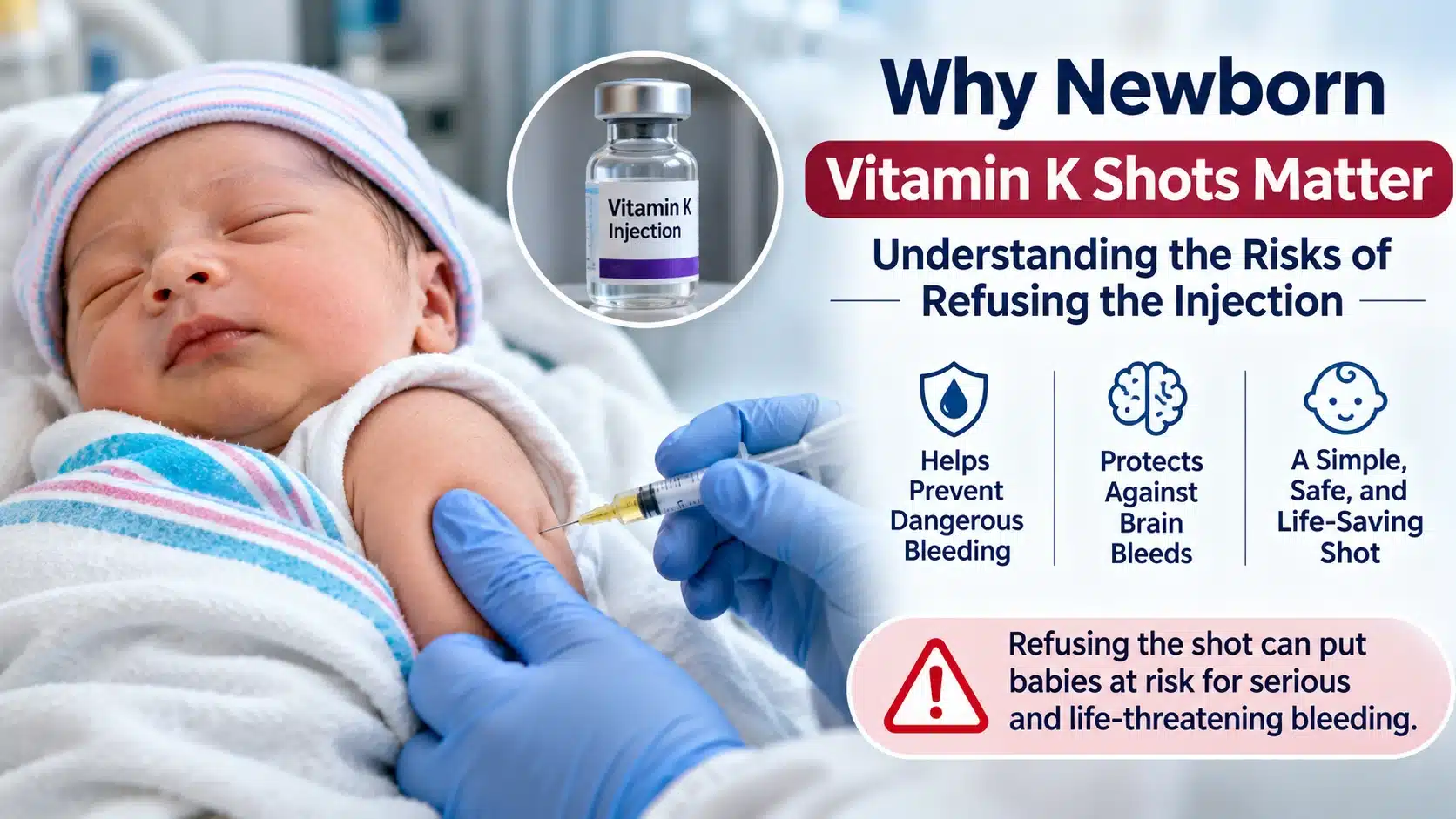
Why Newborn Vitamin K Shots Matter: Understanding the Risks of Refusing the Injection
Published November 10, 2026
For more than 60 years, nearly every baby born in a U.S. hospital has received a quick shot of vitamin K within hours of birth. That routine is now changing. New research shows the share of newborns who don’t get the shot has more than doubled since 2017. Pediatricians are also seeing more babies with a rare but dangerous condition called vitamin K deficiency bleeding (VKDB). Here’s what parents should know about why the shot is recommended, what the latest research shows, and how to make an informed decision with your baby’s doctor.
Growing Concern About Newborn Vitamin K Refusals
Vitamin K helps blood clot. Babies are born with very little of it, so without extra vitamin K, a small number of infants can bleed unexpectedly, sometimes into the brain or gut. A single injection at birth is designed to prevent this.
Two studies published on November 5, 2026, in JAMA and JAMA Pediatrics put national numbers on what many pediatricians had been noticing: more families are declining the shot, and more infants are being diagnosed with bleeding problems. Doctors say the trend is worrying because VKDB is almost entirely preventable.
Why Do Newborns Need Vitamin K?
Your liver uses vitamin K to make several clotting factors, the proteins that help blood form clots and seal injuries. Without enough vitamin K, those proteins don’t work properly, and even minor bleeding can become hard to stop.
Newborns are naturally low in vitamin K for several reasons:
- Little vitamin K crosses the placenta during pregnancy.
- A newborn’s gut doesn’t yet have the bacteria that produce vitamin K in older children and adults.
- Breast milk contains very little vitamin K. Breastfeeding is healthy and recommended, but it can’t supply enough vitamin K on its own. Formula is fortified, but it takes time for levels to build.
- The liver is still immature, so it stores little vitamin K.
These factors leave babies vulnerable for roughly the first six months, until they start eating solid foods and their gut bacteria mature.
What Is Vitamin K Deficiency Bleeding (VKDB)?
VKDB is bleeding caused by a lack of vitamin K. Doctors describe three types, based on when it appears:
- Early VKDB (first 24 hours): rare. It usually occurs in babies whose mothers took certain medications during pregnancy that interfere with vitamin K, such as some seizure drugs or blood thinners.
- Classic VKDB (days 2 to 7): often shows up as bleeding from the umbilical cord, the gut, the nose or circumcision sites.
- Late VKDB (2 weeks to 6 months, most often 3 to 8 weeks): the most dangerous form. It mainly affects breastfed babies who didn’t receive vitamin K at birth. About half of late VKDB cases involve bleeding in the brain, according to the CDC.
VKDB can strike babies who seem completely healthy. Internal bleeding, especially in the brain or abdomen, may give few visible clues until a baby becomes very ill. Without fast treatment, bleeding can cause permanent brain injury or death.
Why Is the Vitamin K Shot Recommended at Birth?
The American Academy of Pediatrics (AAP) has recommended a single intramuscular vitamin K injection for all newborns since 1961. The CDC advises giving it within six hours of birth.
- How it works: the shot, usually given in the thigh, acts quickly. The leftover vitamin K is stored in the liver and released slowly, protecting the baby for several months.
- How effective it is: the CDC reports that babies who don’t get the shot are 81 times more likely to develop severe late VKDB than babies who do.
- Safety: the shot has been used for decades. Side effects are usually limited to brief discomfort or minor bruising where it’s given. A 1990s concern about a possible link to childhood cancer was not confirmed by later, larger studies.
It’s not a vaccine. Vitamin K is a naturally occurring nutrient. The shot doesn’t train the immune system or contain any germ. It simply supplies a vitamin newborns are missing.
What Happens When Parents Refuse the Vitamin K Shot?
Most babies who miss the shot won’t develop VKDB, because the condition is uncommon. But declining it raises the risk substantially. When VKDB does occur, it can lead to:
- Internal bleeding that’s hard to see
- Brain bleeds (intracranial hemorrhage)
- Bleeding in the stomach or intestines
- Emergency care such as blood transfusions, intensive care or brain surgery
- Lasting neurological damage
- Death
What Recent Research Reveals About Rising Refusal Rates
The Children’s Hospital of Philadelphia (CHOP) study in JAMA
Researchers at Children’s Hospital of Philadelphia analyzed electronic health records for more than 5.2 million infants born between 2017 and 2025. The records came from Epic Cosmos, a large database drawn from health systems that use Epic software. The study followed babies through their first six months.
- The share of newborns without a recorded vitamin K shot rose from 3.1% in 2017 to 5.6% in 2024 and 6.8% in 2025.
- Babies who didn’t get the shot had a 47% higher risk of any bleeding event by 6 months, after adjusting for factors such as gestational age and insurance status.
- Their risk of brain bleeding more than doubled, as did their risk of dying during the birth hospitalization, according to ABC News coverage of the study.
In plain terms, the authors estimated that for roughly every 114 babies who miss the shot, one additional baby has a recorded bleeding event. The study has limits. It relied on hospital records, it underrepresented home and birth-center births, and it couldn’t capture care received outside participating health systems. Bleeding rates also rose somewhat among babies who did get the shot, which the researchers said may partly reflect better detection.
Separate reporting on rising VKDB cases
A second study, published the same day in JAMA Pediatrics by a different team, found that recorded VKDB diagnoses climbed sharply between 2017 and 2025. It used a different dataset and different methods, so its numbers shouldn’t be combined with the CHOP figures. ProPublica has also reported that the federal government doesn’t systematically track vitamin K refusals or VKDB cases, which makes the full picture harder to see.
Vitamin K Injection vs. Oral Vitamin K Drops
Some parents ask about oral vitamin K drops instead of a shot. Here’s how they compare:
| Intramuscular injection | Oral drops | |
|---|---|---|
| Doses | One shot at birth | Multiple doses over weeks or months |
| Absorption | Reliable; stored in the liver for slow release | Variable; affected by spitting up, digestion and certain liver or gut conditions |
| Missed doses | Not an issue | Common in real life, leaving gaps in protection |
| Evidence | Decades of strong data for preventing all forms of VKDB | Less effective against late VKDB in most studies |
| U.S. status | Recommended by the AAP and CDC | No FDA-approved oral newborn formulation; not recommended by the AAP |
Some countries use approved oral regimens with carefully scheduled repeat doses. Even there, oral approaches generally offer less protection than the injection. In the U.S., oral products are typically supplements that aren’t designed or tested for newborn prophylaxis, which is why the AAP recommends the shot.
Why Are More Parents Refusing Vitamin K Injections?
Parents who decline the shot usually do so out of love and a desire to protect their baby. Common concerns include:
- Needles and discomfort: not wanting a newborn’s first hours to include pain. Doctors note the discomfort is brief, and skin-to-skin contact or breastfeeding during the shot can help comfort the baby.
- Ingredients and preservatives: some formulations contain small amounts of preservatives, but preservative-free versions are available. Parents can ask which one the hospital uses.
- Confusion with vaccines: the shot is often grouped with newborn vaccines, but it isn’t one.
- Social media misinformation: including claims that the shot is unnecessary, toxic or linked to cancer, which large studies haven’t supported.
- Distrust of healthcare institutions, which has grown in recent years.
- A preference for natural birth and fewer interventions.
- General worries about medication safety for newborns.
These concerns are understandable. The evidence, however, consistently shows that the benefits of the shot far outweigh its small risks.
A Real-Life Case: Baby Gwen’s Death and the Emergency-Care Failures
A November 2026 investigation by ProPublica told the story of Gwen Biesenbach, an 11-day-old girl in Texas. The account below separates what each source says.
- The family’s decision: according to ProPublica’s reporting, Gwen’s parents chose oral vitamin K drops instead of the injection at birth.
- The bleeding: the parents told ProPublica that Gwen’s belly button began bleeding and wouldn’t stop. After contacting their midwife, they took her to a freestanding emergency room near their home.
- In the ER: medical records reviewed by ProPublica show the ER physician tried several methods to stop the bleeding. The family said a nurse told them the facility didn’t have injectable vitamin K on hand. Gwen was eventually transferred to a hospital in San Antonio.
- The physician’s account: the ER doctor, Nicole Malouf, told ProPublica that she believed she had done everything she could with the resources available. She said the ER has since trained staff on vitamin K and now keeps it in stock.
- Official findings: the Texas Medical Board found that Malouf failed to recognize Gwen’s vitamin K–dependent bleeding disorder and failed to transfer her promptly to a pediatric hospital. The board required her to complete continuing medical education.
- Outcome: Gwen died. The medical examiner listed the cause of death as vitamin K deficiency bleeding.
Gwen’s case shows two problems at once. Missing the injection left her vulnerable to VKDB. Then, according to the medical board, delays in recognizing and treating the condition meant she didn’t get timely care. Her parents told ProPublica they believe those medical errors were the main reason she died. Doctors stress that vitamin K should be given right away whenever VKDB is suspected, even before tests confirm it.
Warning Signs of Vitamin K Deficiency Bleeding
Seek emergency care immediately if a baby has:
- Bleeding from the umbilical cord area that won’t stop
- Unexplained bruising, especially on the head or face
- Blood in stool (red, or black and tarry) or urine
- Bleeding from the nose or mouth
- Oozing that won’t stop from a heel prick, circumcision or shot site
- Unusual irritability or high-pitched crying
- Poor feeding or repeated vomiting
- Unusual sleepiness, floppiness or trouble waking
- Seizures
- A bulging soft spot or other signs of a neurological problem
VKDB can cause serious internal bleeding with no visible warning signs. If your baby didn’t get vitamin K at birth, tell every healthcare provider who treats your child, including in an emergency room.
Can Vitamin K Deficiency Cause Permanent Brain Damage?
Yes. When VKDB causes bleeding inside the skull (intracranial hemorrhage), the pressure and blood loss can injure the brain. Possible long-term effects include:
- Seizures and epilepsy
- Developmental delays
- Movement disorders, including cerebral palsy
- Learning and intellectual disabilities
- Vision or hearing problems
- Death in severe cases
Vitamin K can stop further bleeding within hours, but it can’t undo bleeding that has already happened. That’s why early diagnosis and treatment, and above all prevention, matter so much.
What Parents Should Know Before Declining the Vitamin K Shot
- Talk to your pediatrician or midwife before delivery about the benefits and risks, so you’re not deciding in a rushed moment.
- Ask about ingredients. If preservatives concern you, request a preservative-free formulation.
- Understand the limits of oral drops. They require multiple doses, aren’t FDA-approved for this use in the U.S., and protect less reliably.
- Know that breastfeeding alone won’t provide enough vitamin K, even though breast milk is otherwise ideal nutrition.
- Use reliable sources such as the AAP, the CDC and your baby’s healthcare team.
- If you decline, learn the warning signs and tell every provider your baby didn’t receive the shot.
Choosing the shot is a decision you make together with qualified professionals who can answer your specific questions.
How Pediatricians Are Responding to Increasing Refusals
Many pediatricians and nurses are changing how they talk with families:
- Starting conversations earlier, during prenatal visits, instead of right after birth.
- Listening first, asking what worries parents before offering information.
- Clearly explaining that vitamin K is a vitamin, not a vaccine.
- Addressing misinformation directly with clear, evidence-based answers.
- Offering comfort measures, such as giving the shot during skin-to-skin contact or breastfeeding.
- Making sure emergency departments stock vitamin K and know how to recognize VKDB, a lesson highlighted by Gwen’s case.
- Calling for better tracking, so public health officials can monitor refusals and bleeding cases nationally.
Conclusion: Protecting Newborns From Preventable Bleeding
Every baby starts life low in vitamin K, and a single shot at birth is a simple, well-tested way to protect against rare but potentially devastating bleeding. New research shows more families are declining that protection, and more babies are being diagnosed with bleeding as a result. Most babies who miss the shot will be fine, but those who aren’t can suffer brain damage or die from a condition that’s almost entirely preventable. If you have questions about the vitamin K shot, raise them with your pediatrician before your baby arrives. If a newborn ever shows signs of unusual bleeding, get emergency care right away.
Find more evidence-based health guides on Learning Joan.
This article is for general information only and is not a substitute for professional medical advice. Talk to your baby’s healthcare provider about any questions regarding newborn care.
