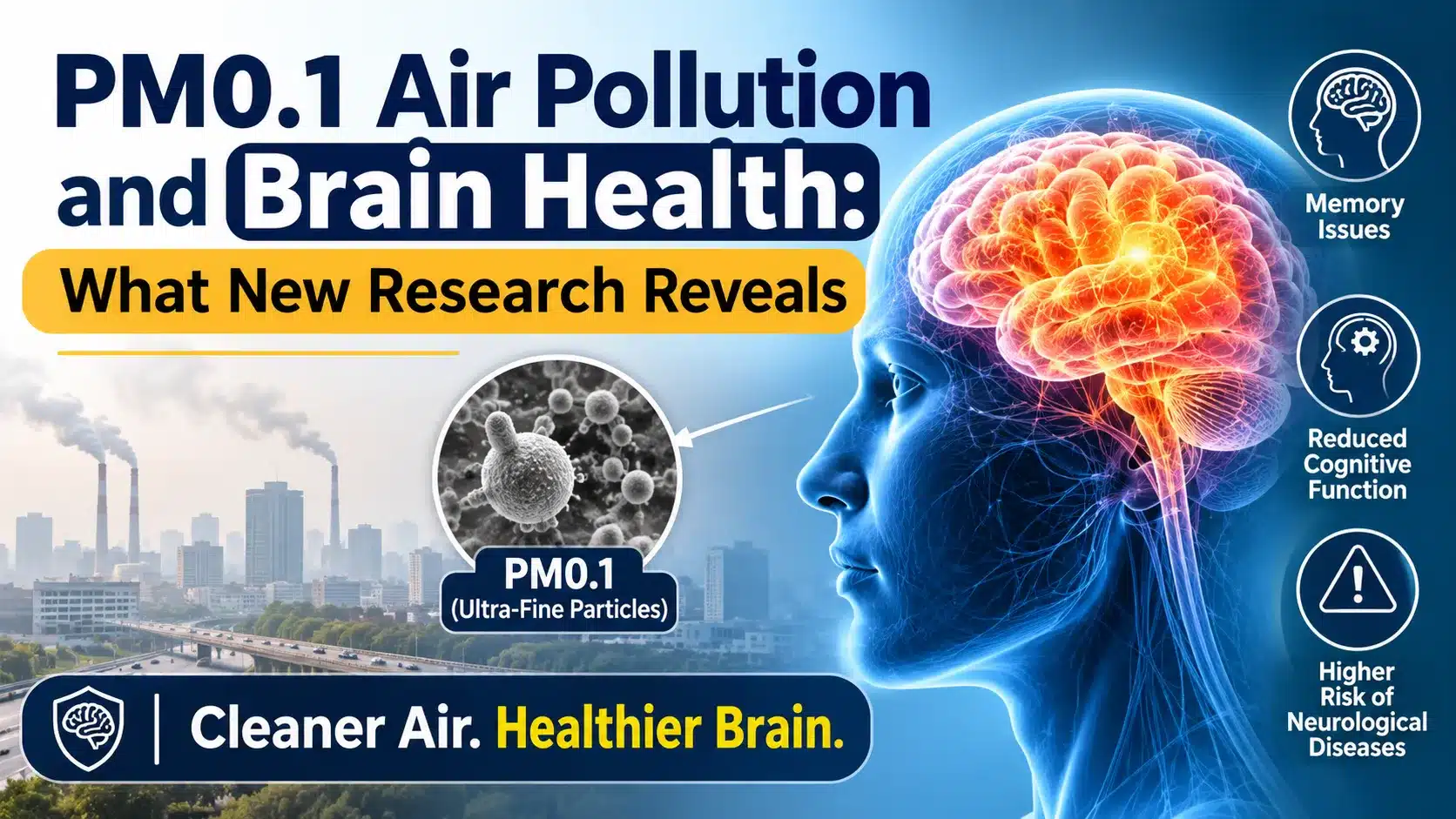
PM0.1 Air Pollution and Brain Health: What New Research Reveals
Air pollution is usually thought of as a lung problem, but a growing body of research suggests its effects may reach much further, including the brain. The tiniest particles, known as ultrafine particles or PM0.1, are small enough to raise questions about how they interact with the bloodstream and blood vessels. In November 2026, a study from Case Western Reserve University and University Hospitals in Cleveland added new evidence, linking pollution to higher dementia risk in people and to changes in brain immune cells in mice. Here is what the research on PM0.1 air pollution and brain health shows, and what it does not.
What Is PM0.1 and How Is It Different From PM2.5?
Particulate matter (PM) is a mix of tiny solid and liquid particles in the air. It is grouped by size, measured in micrometres (µm):
- PM10: particles 10 µm or smaller, such as dust and pollen.
- PM2.5: fine particles 2.5 µm or smaller, about 30 times thinner than a human hair. These come largely from vehicle exhaust, industry and burning.
- PM0.1: ultrafine particles 0.1 µm (100 nanometres) or smaller, produced mainly by combustion, such as traffic, cooking and burning fuel.
Smaller particles can travel deeper into the lungs and have a larger surface area relative to their mass, which can carry more chemicals. But size is not the only factor. A particle’s chemical makeup, its source, how much is in the air, how long people are exposed and individual health all affect how harmful it is.
Most air-quality standards measure PM2.5 and PM10. PM0.1 is not routinely monitored in most cities, so far less is known about everyday exposure.
How Ultrafine Particles May Enter the Bloodstream
When we breathe, particles settle in different parts of the airways. Ultrafine particles can reach the tiny air sacs (alveoli) where oxygen passes into the blood.
Researchers are studying several ways pollution may affect the body beyond the lungs:
- Direct translocation: Some ultrafine particles may cross from the lungs into the blood. Laboratory and animal studies support this, and limited human studies suggest it can occur, but only a small share of inhaled particles is thought to do so.
- Systemic inflammation: Irritation in the lungs can release inflammatory signals into the bloodstream, affecting organs throughout the body.
- Chemical effects: Metals and other compounds attached to particles may dissolve and circulate.
Not every inhaled particle enters the bloodstream or reaches the brain. The relative importance of each pathway in people is still being studied.
Can Air Pollution Reach the Brain?
Scientists have proposed several ways pollution may affect the brain:
- Oxidative stress: harmful molecules that damage cells.
- Neuroinflammation: ongoing inflammation in brain tissue.
- Blood-brain barrier disruption: weakening of the brain’s protective lining.
- Immune-cell changes: altered activity of the brain’s defence cells.
- Energy changes: disruption of how brain cells produce and use energy.
- Effects on neurons: reduced survival or function of nerve cells.
Some ultrafine particles may also reach the brain directly through the nose and olfactory nerve, based on animal research. Which pathways matter most likely depends on the type of particle, the level of exposure and a person’s health.
New 2026 Study Links Pollution to Brain Immune-Cell Changes
On November 23, 2026, University Hospitals announced new research from Case Western Reserve University, University Hospitals and the Louis Stokes Cleveland VA Medical Center. The study, “Air pollution exposure interacts with Alzheimer’s genetic susceptibility to reshape microglial epigenomic and transcriptional programs,” was published in the Journal of Neuroinflammation.
It was led by co-senior authors Dr. Sanjay Rajagopalan, director of the Cardiovascular Research Institute at Case Western Reserve, and Dr. Andrew Pieper, a neuropsychiatry researcher at Case Western Reserve and University Hospitals. The research combined a large human data analysis with mouse experiments. South Korean outlet The Chosun also reported on the same study.
What the UK Biobank Analysis Found About Dementia Risk
The researchers analysed health records from about 500,000 adults in the UK Biobank, followed for up to 14 years. People living in the most polluted third of areas had a 25% higher risk of Alzheimer’s disease or a related dementia than those in the least polluted third. The link held after adjusting for age, smoking, diabetes and other factors, and appeared regardless of people’s inherited genetic risk for Alzheimer’s.
That 25% is a relative difference. It does not mean 25 out of every 100 people exposed will develop dementia. If a group’s baseline risk were, for example, 4%, a 25% relative increase would raise it to about 5%.
This was an observational analysis. It shows an association, not proof that pollution caused dementia in any individual. Other factors linked to where people live could also play a role.
How PM2.5 Affected the Brain in Mouse Experiments
To study possible mechanisms, the team exposed mice for about five months to outdoor Cleveland air with PM2.5 concentrated to levels similar to the world’s most polluted cities. Note that these experiments used PM2.5, not PM0.1 alone.
In otherwise healthy mice, exposure was linked to:
- Memory problems.
- Brain inflammation.
- A leaky blood-brain barrier.
- A lower NAD+/NADH ratio, a marker of cellular energy and resilience.
- Increased death of newly formed neurons in the hippocampus, a memory centre.
- Changes in microglial gene activity.
These Alzheimer’s-like changes occurred without amyloid plaques. In mice genetically prone to Alzheimer’s, pollution caused the same harms and also accelerated amyloid plaque buildup.
These are animal findings. Mice are useful for studying biology, but the results do not directly prove the same effects occur in people.
What Are Microglia and Why Do They Matter?
Microglia are the brain’s resident immune cells. They clear away debris and damaged cells, respond to infection, regulate inflammation and help keep the brain’s environment healthy.
In the study, pollution changed which genes were switched on in microglia. Think of genes as instructions: pollution appeared to change which instructions the cells followed. Rajagopalan said pollution causes major changes in which genes are active in the brain’s immune cells. According to the researchers, these changes disrupted the cells’ normal roles in clearing debris and fighting infection.
The study does not show that these changes are permanent. Whether they can be reversed is an open question.
How Air Pollution May Damage the Blood-Brain Barrier
The blood-brain barrier is a tightly sealed layer of cells lining brain blood vessels. It lets nutrients in while keeping out many harmful substances.
Inflammation, oxidative stress, changes to blood vessel function and particle-related chemicals may all weaken it. When the barrier becomes leaky, immune cells and molecules that are normally kept out can enter brain tissue, potentially fuelling inflammation.
The mouse study observed barrier damage, but it did not determine how much was due to particles entering directly versus indirect inflammatory effects.
PM0.1, Brain Haemorrhage and Other Vascular Risks
Medical experts, including in a Business Today video discussion, have raised concerns that ultrafine particles in the bloodstream may raise the risk of brain bleeds and other diseases. That discussion is expert commentary, not a clinical study.
Here is what is well established. The World Health Organization links fine particulate pollution to heart disease and stroke. Pollution can raise blood pressure, inflame blood vessels and make blood more likely to clot.
- Ischaemic stroke: caused by a blocked artery. This is the type most strongly linked to air pollution.
- Haemorrhagic stroke: caused by bleeding in the brain. Some studies link pollution to higher risk, but the evidence is less consistent.
- Cerebral small-vessel disease: damage to tiny brain blood vessels, which is being studied in relation to pollution.
There is no evidence that PM0.1 directly causes brain haemorrhage in every exposed person. High blood pressure, age and other factors remain the main drivers of brain bleeds. Learn more about heart health.
Does Air Pollution Increase Alzheimer’s Disease Risk?
Research increasingly links long-term exposure to fine particles with higher risk of dementia and cognitive decline. The Lancet Commission on dementia includes air pollution among its modifiable risk factors.
It helps to separate three ideas: dementia risk (the chance of developing dementia), Alzheimer’s pathology (brain changes like amyloid plaques) and a clinical diagnosis (symptoms confirmed by a doctor). The Cleveland study offers observational human data on risk and mechanistic mouse data on pathology, but no direct clinical proof.
Air pollution is not the sole cause of Alzheimer’s. Age, genetics, heart health, diabetes, hearing loss and physical inactivity all play roles. See our guide to mental and brain health.
Other Health Effects of Ultrafine Particles
Fine particle pollution is firmly linked to heart disease, stroke, asthma, chronic obstructive pulmonary disease and lung cancer. Research is also exploring links with diabetes and metabolic effects, chronic inflammation and neurological disorders. These emerging links need more study.
Why the Findings Matter in Highly Polluted Cities
Cities with heavy traffic, industry, construction dust, biomass burning and wildfire smoke can see very high particle levels. Many pollutants also form in the air from gases, called secondary particles.
Cities in South Asia, including parts of northern India, regularly record PM2.5 levels many times above WHO guidelines during winter. The Cleveland study did not measure people in India, but its concentrated exposure was designed to mimic highly polluted cities.
Personal exposure varies by location, season, job, time spent outdoors and indoor air quality.
How to Reduce Exposure to Fine and Ultrafine Particles
- Check local air-quality index readings daily.
- Limit strenuous outdoor exercise on high-pollution days.
- Ventilate your home when outdoor air is cleaner.
- Use a properly sized HEPA air purifier and change filters as directed.
- Avoid indoor smoking, incense and poorly vented stoves.
- Follow local health advisories.
- Wear a well-fitted N95 or equivalent respirator when advised.
- Support clean-air policies.
These steps reduce exposure but cannot eliminate it. Broader emissions cuts are the most effective long-term solution.
What Scientists Still Need to Discover
- Which particle sizes and chemicals are most harmful?
- How much exposure causes measurable brain effects?
- Which biological pathways matter most?
- Can microglial changes be reversed?
- Who is most vulnerable?
- Can reducing exposure lower dementia risk?
- How do PM0.1 and PM2.5 differ in their effects on the brain?
- How strong is the link between pollution and brain bleeds?
Long-term human studies, better monitoring of ultrafine particles and clinical research will be needed to answer these questions.
Scientific evidence at a glance
| Finding | Source | Evidence type | What it means | What it does not prove |
|---|---|---|---|---|
| 25% higher dementia risk in most polluted areas | UK Biobank analysis, 2026 | Human observational | Pollution is associated with higher risk | That pollution caused dementia in individuals |
| Memory loss, inflammation, leaky barrier in mice | Cleveland mouse study, 2026 | Animal experimental | PM2.5 can harm the brain in mice | Same effects in humans |
| Microglial gene changes | Cleveland mouse study, 2026 | Animal experimental | A possible mechanism for harm | Permanent or irreversible damage |
| Ultrafine particles may raise brain bleed risk | Business Today expert discussion | Expert commentary | A concern worth studying | Direct cause of haemorrhage |
| PM2.5 linked to heart disease and stroke | WHO | Established public health | Strong evidence of harm | Equal risk for every person |
| PM0.1 crossing into blood and brain | Lab and animal studies | Emerging | A plausible pathway | That most particles reach the brain |
Frequently Asked Questions
What is PM0.1 air pollution?
Ultrafine particles 0.1 micrometres or smaller, mostly from combustion such as traffic and burning.
How is PM0.1 different from PM2.5?
PM0.1 is far smaller and is not routinely monitored. PM2.5 includes all fine particles up to 2.5 µm.
Can ultrafine particles enter the bloodstream?
Some may, based on lab, animal and limited human research, but only a small share is thought to cross.
Can air pollution affect the brain?
Research suggests it may, through inflammation, barrier damage and immune-cell changes.
What are microglia?
The brain’s immune cells, which clear debris, fight infection and regulate inflammation.
How can air pollution affect the blood-brain barrier?
In mice, PM2.5 exposure made the barrier leaky, possibly through inflammation and oxidative stress.
Does air pollution increase dementia risk?
Studies link long-term exposure to higher risk, including a 25% relative increase in the UK Biobank analysis.
Can PM0.1 cause brain haemorrhage?
Experts have raised concerns, but there is no strong evidence it directly causes brain bleeds.
What did the November 2026 University Hospitals study find?
Pollution was linked to higher dementia risk in people and to memory loss, inflammation and microglial changes in mice.
Can air purifiers reduce particulate exposure?
Properly sized HEPA purifiers can lower indoor particle levels.
How can people reduce exposure to ultrafine particles?
Check air quality, limit outdoor exertion on bad days, use purifiers and avoid indoor smoke.
Is air pollution the only cause of Alzheimer’s disease?
No. Age, genetics and many health and lifestyle factors also contribute.
Conclusion
New research strengthens the case that air pollution may affect the brain, not just the lungs. The Cleveland study links pollution to higher dementia risk in people and to immune-cell and barrier changes in mice. Much remains unknown, especially about PM0.1, but reducing exposure and supporting cleaner air are sensible steps for brain and heart health.
Find more evidence-based health guides on Learning Joan.
