Christina Applegate Questions Whether Breast Implants Are Behind Her Health Struggles After MS Misdiagnosis
Published November 12, 2026
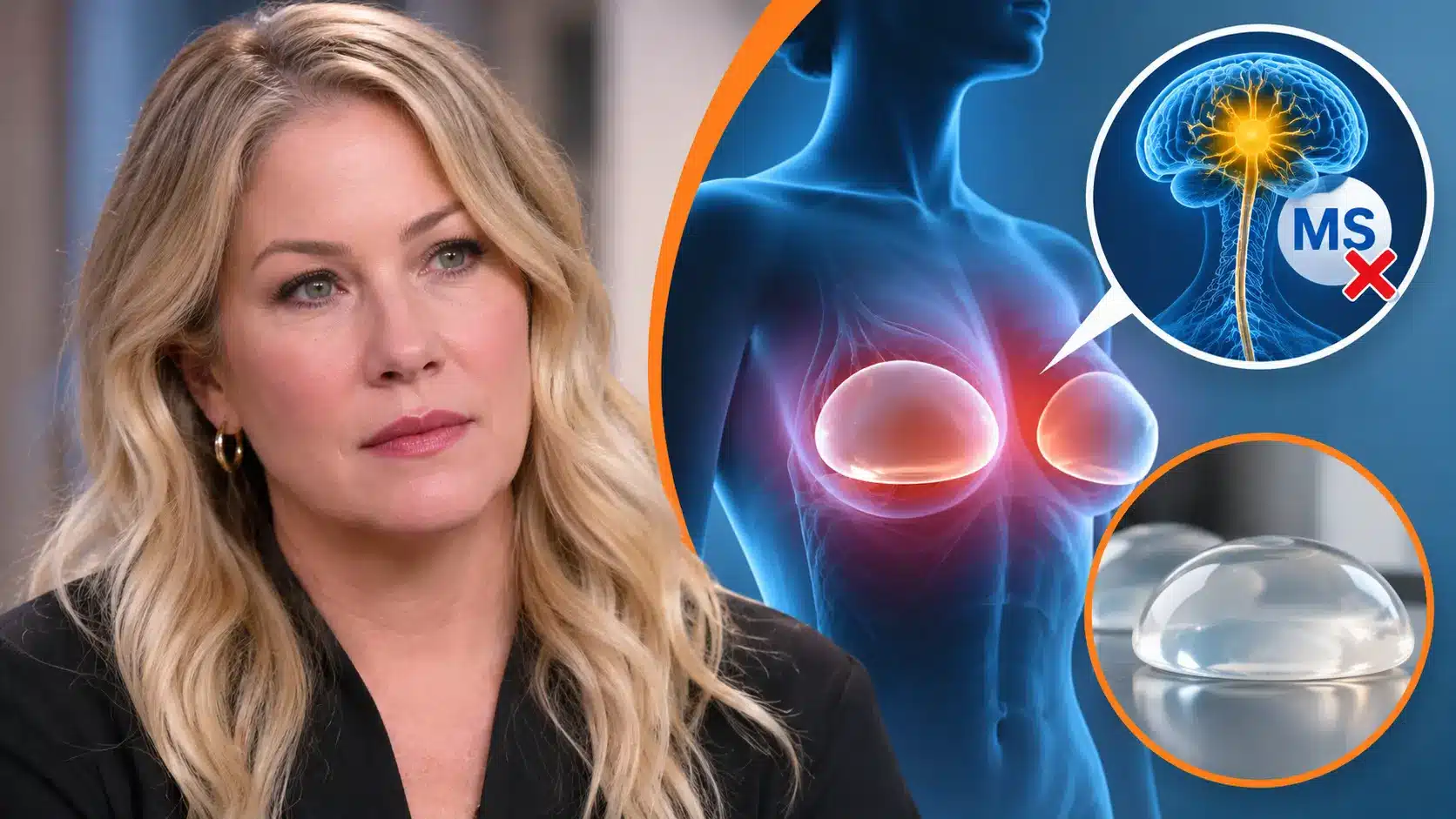
Christina Applegate is still searching for answers. A few weeks after revealing that doctors told her she does not have multiple sclerosis, the 54-year-old actress said on her podcast that she wonders whether her aging breast implants could be behind the pain and fatigue she has lived with for years. She was clear that it’s only a question she plans to explore. No doctor has linked her implants to her symptoms, and she has not received a new diagnosis.
Christina Applegate’s Health Update: From MS to “Square One”
Applegate announced in August 2021 that she had been diagnosed with MS, a disease in which the immune system damages the protective coating around nerves. For the next several years, she spoke openly about losing mobility, chronic pain and stepping away from on-camera acting.
This fall, she told listeners of MeSsy, the podcast she co-hosts with Sopranos actress Jamie-Lynn Sigler, that a doctor had walked into her hospital room and said she did not have MS. Instead of relief, she described feeling deeply unsettled. She said the news put her “back at square one,” because her symptoms haven’t gone away.
Applegate has described how hard daily movement has become. On a recent episode, she said getting out of bed can take around 10 minutes and that she keeps a walker beside her bed.
Testing for conditions that can mimic MS
Applegate said she is now being tested, step by step, for conditions that can resemble MS, naming rheumatoid arthritis, lupus and Lyme disease. Rheumatoid arthritis and lupus are autoimmune diseases that can cause joint pain, fatigue and inflammation. Lyme disease is a bacterial infection spread by ticks that, if untreated, can affect the joints and nervous system. As of this writing, she has not announced a diagnosis.
A neurologist who appeared on MeSsy, Marwa Kaisey, MD, of Cedars-Sinai, explained that MS can be difficult to diagnose because there’s no single definitive test. Doctors often reach a diagnosis by ruling out other causes.
Why Christina Applegate Is Asking About Her Breast Implants
Applegate was diagnosed with breast cancer in 2008. After testing positive for a BRCA1 gene mutation, she had a double mastectomy followed by breast reconstruction with implants.
On the November 10 episode of MeSsy, she said someone had sent her information suggesting that problems with breast implants could cause symptoms resembling MS. She noted that her implants are about 18 years old and, in her words, “way overdue” for replacement. She said she has wondered for years whether they might be leaking, and that she plans to look into the idea.
That’s her suspicion, not a medical finding. Neither Applegate nor her doctors have said her implants are ruptured or that they’re causing her symptoms.
What Is Breast Implant Illness?
Breast implant illness, often shortened to BII, isn’t a formal medical diagnosis. It’s a term patients and researchers use for a range of whole-body symptoms that some people with implants report. According to the U.S. Food and Drug Administration, reported breast implant illness symptoms include:
- Fatigue
- Memory problems or “brain fog”
- Joint and muscle pain
- Rash
- Hair loss
- Anxiety, depression or sleep problems
The FDA’s labeling guidance states that researchers are still investigating these symptoms and that their exact relationship with breast implants is unclear. Some patients report that their symptoms improve after their implants are removed, but studies haven’t established that implants cause these problems, or who might be at risk. There’s no lab test that confirms BII, so doctors usually evaluate patients by ruling out other conditions.
Breast implant safety: what the FDA requires
Since 2021, the FDA has required breast implant labeling to include a boxed warning, the agency’s most prominent type of warning, along with a patient decision checklist. These cover risks including systemic symptoms and a rare immune-system cancer called breast implant-associated anaplastic large cell lymphoma (BIA-ALCL). The FDA also stresses that breast implants aren’t lifetime devices, and that many patients eventually need additional surgery.
Implant Rupture vs. Systemic Symptoms vs. a Confirmed Diagnosis
These three ideas often get blurred together, but they’re different:
- Rupture: a tear in the implant shell. Saline ruptures usually cause visible deflation. Silicone ruptures are often “silent,” with no obvious signs, which is why the FDA recommends periodic imaging for people with silicone gel implants, starting 5 to 6 years after surgery and then every 2 to 3 years.
- Systemic symptoms: whole-body complaints such as fatigue or pain that some patients attribute to their implants. A rupture doesn’t automatically cause them, and they can occur with intact implants.
- A confirmed diagnosis: a specific condition identified through exams, imaging and lab tests. Fatigue and widespread pain have many possible causes, so a careful workup matters before drawing conclusions.
The FDA’s current view is that breast implants are associated with systemic symptoms in some patients. It does not say a causal link has been proven, and that’s especially true for any link to MS-like neurological symptoms.
Christina Applegate and David Faustino: A Lasting Bond
Applegate’s Married… With Children co-star David Faustino, who played her TV brother Bud Bundy, has been a steady public supporter throughout her health journey. Earlier this year, he told reporters that the two “talk often,” adding that she has helped him through difficult times and he hopes to return the favor.
In June, Faustino acknowledged how hard the past few years have been for her. He also said she has held on to her sense of humor, the dry wit fans have known since her Kelly Bundy days. Applegate’s candor on MeSsy, where she often jokes about her own struggles, reflects that same resilience.
The Emotional Weight of Diagnostic Uncertainty
Applegate has said the misdiagnosis left her feeling confused, and even that she had let down the MS community she had come to represent. Living with serious symptoms and no clear explanation can be exhausting. Patients in this position often describe frustration, grief and anxiety alongside the physical toll.
Experts say that’s why mental health support is an important part of care for anyone facing a long diagnostic process. Our guide to calming racing thoughts at night offers a few practical starting points, but it’s not a substitute for professional help.
When to Seek Medical Evaluation
If you have persistent, unexplained symptoms such as ongoing fatigue, widespread pain, numbness, weakness or trouble moving, it’s worth getting a thorough evaluation. That may involve your primary care doctor and specialists such as a rheumatologist or neurologist. If you have breast implants, the FDA recommends contacting your doctor about changes such as breast pain, swelling, lumps or changes in shape, and following recommended screening. Regular checkups also help catch problems early. Here’s how often to get a physical.
Keep in mind that one person’s experience, even a celebrity’s, isn’t a diagnosis for anyone else.
Frequently Asked Questions
Does Christina Applegate have MS?
Applegate said this fall that doctors told her she does not have multiple sclerosis, which she had been diagnosed with in 2021. She is being tested for other conditions.
Why does Christina Applegate think her breast implants could be involved?
She said on her MeSsy podcast that her implants, placed after her 2008 double mastectomy, are overdue for replacement. She has wondered whether they could be leaking. She described this as something she plans to look into, not a diagnosis.
What are breast implant illness symptoms?
The FDA lists reported symptoms including fatigue, brain fog, joint and muscle pain, rash, hair loss, anxiety and depression. Their relationship to implants is still unclear.
Can breast implants cause MS?
There’s no established evidence that breast implants cause multiple sclerosis.
How can I tell if a silicone implant has ruptured?
Silicone ruptures are often silent. The FDA recommends imaging such as MRI or ultrasound 5 to 6 years after surgery and every 2 to 3 years after that, or sooner if you have symptoms.
The Bottom Line
Christina Applegate’s latest health update is a reminder of how hard it can be to get answers when symptoms don’t fit a clear diagnosis. Her question about her breast implants is a reasonable one to raise with her doctors. For now, though, it remains a question, not a confirmed cause. With support from friends like David Faustino and a candid platform on MeSsy, she continues to share her search for answers.
Find more evidence-based health guides on Learning Joan.
This article is for general information only and is not medical advice. If you have persistent symptoms or concerns about breast implants, talk to a qualified healthcare provider.
