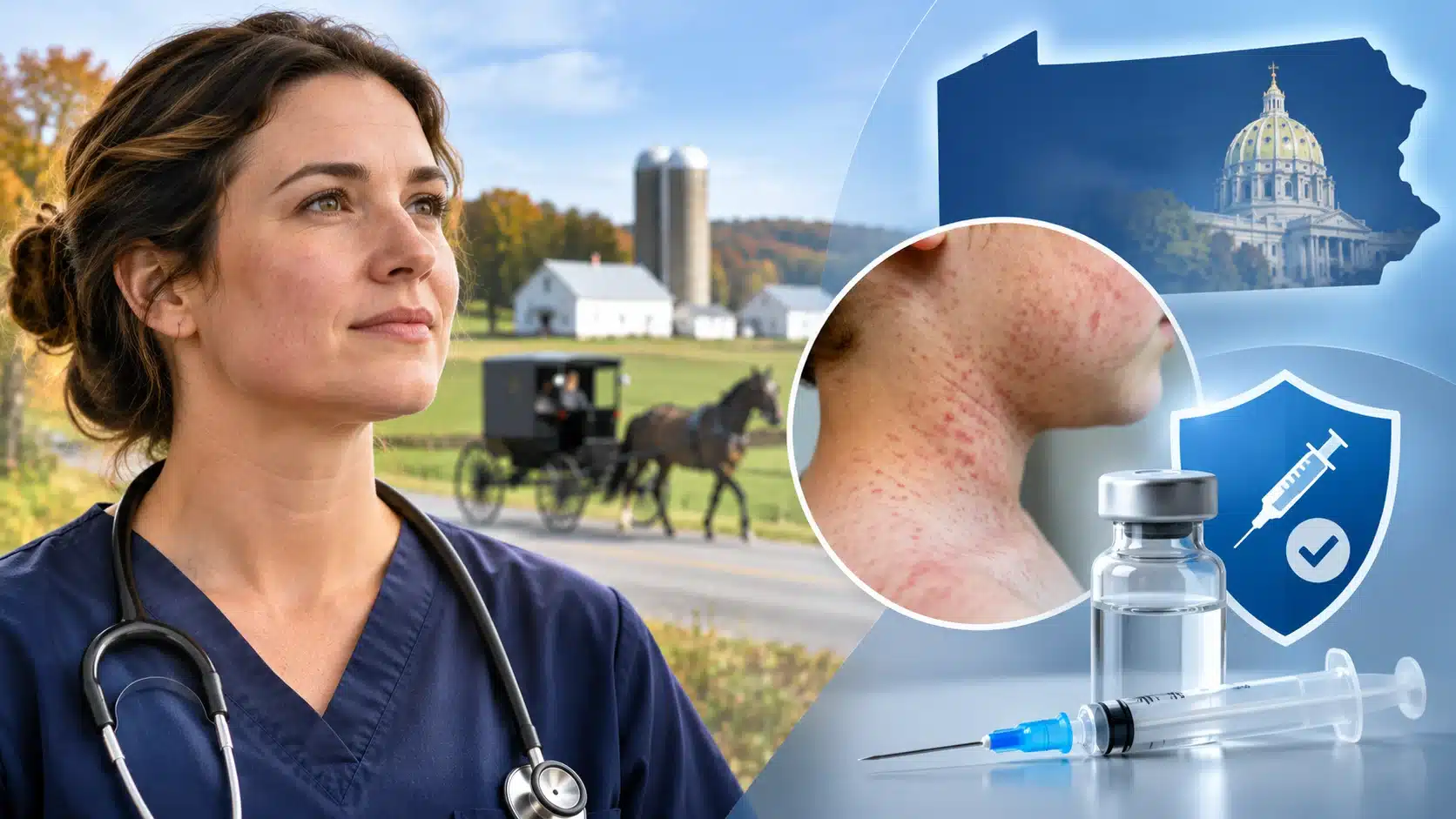
Pennsylvania Measles Outbreak 2026: Midwife’s Experience Changes Vaccine Views
Published November 12, 2026 · Case counts as of November 9, 2026
Pennsylvania is living through its worst measles outbreak in more than three decades, and Lancaster County, home to the country’s largest Amish population, is at its center. As cases climbed past 1,500 statewide, one of the most striking voices to emerge is a traditional midwife named Roberta Devers. She once chose not to vaccinate her own son. Now, after caring for dozens of pregnant women sick with measles, she’s helping families think differently about the MMR vaccine. Here’s what the Pennsylvania measles outbreak of 2026 has revealed about trust, access and protecting the most vulnerable.
Pennsylvania Faces a Serious Measles Outbreak
As of November 9, 2026, the Pennsylvania Department of Health had confirmed 1,505 measles cases across 45 counties this year. That total includes 290 hospitalizations and six measles-associated deaths, according to the department’s latest update reported by abc27. Lancaster County led the state with 514 cases, followed by Mifflin County with 205. Only five cases have occurred in vaccinated people, less than 1% of the total.
The outbreak began in late April. Community leaders say the true number of infections is likely higher, because many people with measles never see a doctor.
Lancaster County’s coroner has disputed the state’s classification of some deaths, arguing those people died with measles rather than of it.
Meet Roberta Devers, the Midwife Who Delivered Nearly 2,000 Babies
Roberta Devers, 63, has worked as a traditional midwife for 38 years and estimates she has delivered nearly 2,000 babies, according to NBC News. She isn’t Amish, but most of her clients are, and many give birth at home. Her practice, Mount Laurel Midwifery, serves families across south-central and southeastern Pennsylvania, according to The Philadelphia Inquirer.
Devers told NBC News she has cared for dozens of pregnant women infected with measles since the outbreak began. She described getting calls almost daily from expectant mothers, or from parents whose babies have caught the virus.
Why the Outbreak Changed Her Perspective on Vaccines
As a young mother, Devers questioned immunizations and chose not to vaccinate her son, NBC News reported. Watching measles move through the families she serves changed her outlook.
She told 6abc that when she gives mothers a balanced view of the MMR vaccine, many decide to get immunized, and that in her experience Amish mothers aren’t against it. She told NBC that families now ask whether she has the vaccine in her car, often unvaccinated husbands worried about bringing the virus home.
Devers has said publicly that she would like Pennsylvania to allow home-birth midwives to give the vaccine. She argues it would be another way to reach families quickly.
How Measles Affects Pregnant Women and Unborn Babies
NBC News reported that state health officials had confirmed measles in 97 pregnant women. Officials have no data on how many miscarriages measles has caused.
Devers attended the burial of a baby lost at 17 weeks of pregnancy. The Inquirer reported that the mother had been recovering from measles at the time, and also had at least one other underlying medical condition. It’s not possible to say from public information that measles caused that loss. Individual cases like this can’t be attributed with certainty without clinical evaluation.
What the medical evidence shows
According to the CDC, measles during pregnancy raises the risk of:
- Miscarriage and stillbirth
- Premature birth and low birth weight
- Severe illness in the mother, including pneumonia and hospitalization
- Measles in the newborn if the mother is infected close to delivery
Anyone pregnant who has been exposed to measles, or has fever and rash, should call a healthcare provider right away.
Why Infants Face Serious Measles Complications
Measles is one of the most contagious diseases known. It spreads through the air, can linger in a room for up to two hours, and infects up to 9 in 10 unprotected people who are exposed.
Measles symptoms in babies usually start with high fever, cough, runny nose and red, watery eyes, followed by a rash. Young children face the highest risk of:
- Pneumonia, the most common cause of measles deaths in children
- Dehydration from diarrhea and poor feeding
- Encephalitis, a brain swelling that can cause lasting damage
- Hospitalization and death
In Pennsylvania, children from birth to age 4 have had the highest hospitalization rate of any age group, according to state data reported by LancasterOnline. Babies are routinely vaccinated at 12 to 15 months, so infants younger than that depend on the immunity of people around them. During outbreaks, the CDC allows an early dose for infants 6 to 11 months old.
Understanding Vaccine Hesitancy in Amish Communities
About 45,000 Amish and 6,000 Old Order Mennonites live in and around Lancaster County, according to the Young Center for Anabaptist and Pietist Studies at Elizabethtown College. Vaccine views among these “Plain” communities vary widely between church districts and families.
There’s no universal Amish religious ban on vaccines. A Lancaster County scholar told the Associated Press that nothing in Amish theology or historic documents specifically opposes immunization. Hesitancy is more often shaped by:
- A preference for traditional remedies and infrequent doctor visits
- Practical barriers, such as travel by horse and buggy, cost and clinic hours
- Distrust of outside institutions, which takes time to overcome
- Misinformation, including anti-vaccine messaging aimed directly at Plain communities
Kindergarten vaccination rates have also fallen across central Pennsylvania, not only in Amish areas.
How Pennsylvania’s Vaccination Rates Have Changed
A 2025 NBC News and Stanford University investigation found that childhood vaccination rates had dropped in more than three-quarters of U.S. counties since 2019. Pennsylvania reflects that trend.
- 2020–21 school year: 95.5% of Pennsylvania kindergartners had their MMR shots, according to CDC data reported by Axios.
- 2025–26 school year: MMR coverage fell to 92.7%, and the state’s kindergarten exemption rate held at about 6%.
- Lancaster County: roughly 88% of kindergartners were up to date on measles vaccines in the most recent school year reported, according to state data cited by the AP.
Why 95% matters
Two MMR doses are about 97% effective. When roughly 95% of a community is immune, measles struggles to spread. This herd immunity also protects babies who can’t yet be vaccinated.
How Word-of-Mouth Vaccination Campaigns Are Building Trust
NPR and the Associated Press have both reported on community-centered efforts to reach Plain families. They include:
- Pop-up and home-based clinics. The state Department of Health had given more than 5,700 MMR doses at 192 pop-up clinics in affected areas by early October, according to LancasterOnline.
- Clinics hosted by trusted local businesses and community health centers. One local health center’s small clinics for Plain families had delivered about 450 measles shots, the AP reported.
- Word of mouth from neighbors, church members and trusted figures like midwives
- Unhurried conversations that answer questions instead of pressuring families
A community health leader told the AP that the most effective approach is to encourage vaccination, not push it aggressively. Trust is built over time, and respect makes access feel safe rather than coercive.
Why Traditional Midwives Matter in Rural Healthcare
For many Amish women, a traditional midwife is the healthcare provider they see most often, which makes midwives natural sources of health information.
Pennsylvania draws a legal line between certified nurse-midwives, who are licensed and can prescribe and administer vaccines, and traditional (unlicensed) midwives like Devers. Traditional midwives aren’t regulated by the state and can’t legally give vaccines.
Changing those rules is one option, but not the only one. Midwives can also share accurate information and connect families with clinics or home visits by licensed providers.
Can Pregnant Women Receive the MMR Vaccine?
No. The MMR vaccine contains weakened live viruses, so the CDC advises against giving it during pregnancy. Instead:
- Before pregnancy: women should confirm they’re immune and get vaccinated if needed, then wait at least four weeks before becoming pregnant.
- During pregnancy: a blood test can check immunity. Non-immune women can be vaccinated after delivery, and MMR is safe while breastfeeding.
- Household protection: vaccinating husbands, children and other family members reduces the chance measles reaches a pregnant woman.
- After exposure: pregnant women without evidence of immunity should contact a clinician immediately. Immune globulin, an antibody treatment, may be recommended within six days of exposure.
What Public Health Experts Recommend
Health officials advise two on-time MMR doses for children, vaccination for adults without proof of immunity, calling ahead before visiting a clinic if you suspect measles, and staying home while contagious.
Claims that MMR causes autism have been studied extensively and not supported by evidence, according to the CDC. Correcting myths works best through respectful conversation, not shame.
Lessons From Pennsylvania’s Measles Outbreak
The outbreak shows how quickly measles returns when vaccination coverage slips, and how much rural healthcare access matters. Trusted messengers, like a midwife who has delivered a community’s babies for decades, can sometimes reach families more effectively than any official campaign.
Frequently Asked Questions
How many measles cases are there in Pennsylvania in 2026?
As of November 9, 2026, the state reported 1,505 confirmed cases, 290 hospitalizations and six measles-associated deaths.
Why is Lancaster County the center of the outbreak?
It has 514 cases, the most in the state, partly because of lower vaccination rates in parts of the county.
Is measles dangerous during pregnancy?
Yes. It raises the risk of miscarriage, stillbirth, premature birth and severe illness in the mother. Pregnant women exposed to measles should call a clinician right away.
Can I get the MMR vaccine while pregnant?
No. MMR is a live vaccine and isn’t given during pregnancy. Get vaccinated before pregnancy or after delivery, and make sure your household is protected.
Do the Amish oppose vaccines for religious reasons?
Not as a rule. Experts say there’s no universal Amish religious prohibition. Views vary, and access and trust often play larger roles.
What are measles symptoms in babies?
High fever, cough, runny nose and red, watery eyes, followed by a rash. Call a doctor promptly.
Conclusion
Roberta Devers’ journey from vaccine skeptic to advocate captures something important: facts matter most when they come from people families already trust. Protecting pregnant women and babies will depend on high vaccination coverage, accessible care and respectful conversations. If you have questions about measles or the MMR vaccine, talk with a healthcare provider you trust.
Find more evidence-based health guides on Learning Joan.
This article is for general information only and is not medical advice. Case numbers change frequently; check the Pennsylvania Department of Health for the latest figures.
