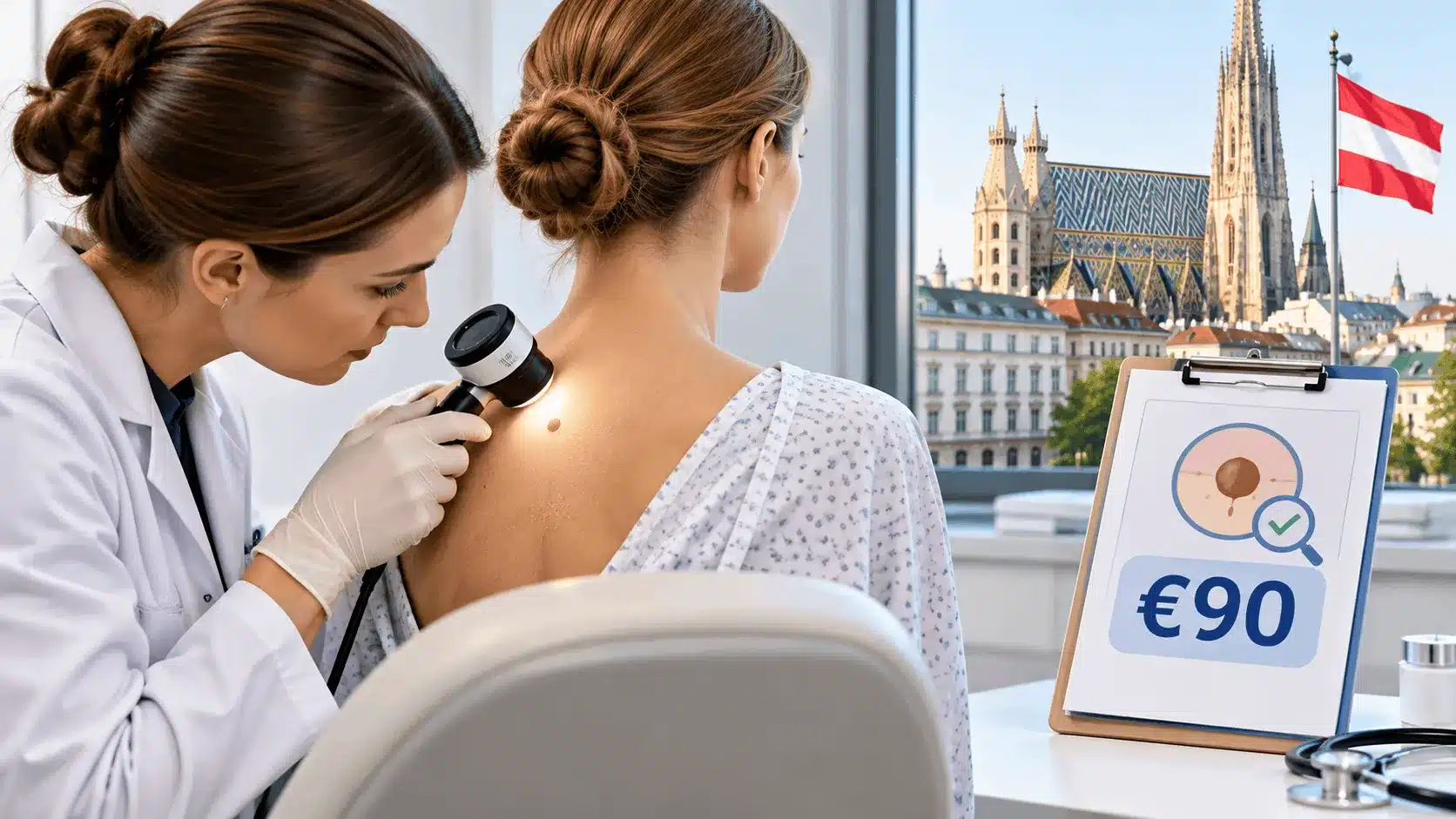
Vienna’s €90 Mole Check: Why Skin Cancer Screening Is Becoming a Private Service
Published November 13, 2026
For years, many Viennese booked a yearly “Muttermalkontrolle” with their dermatologist and never saw a bill. That routine is changing. The Vienna Medical Chamber (Ärztekammer Wien) now recommends treating preventive full-body mole checks for people without symptoms or elevated risk as a private service, with a suggested fee of €90. Austria’s main public insurer says nothing in its contracts has changed. Patients with suspicious moles or a higher skin cancer risk remain covered. Here’s what the Vienna €90 mole check means in practice.
What Changed for Mole Checks in Vienna in 2026?
According to ORF Wien, full-body preventive mole checks at Vienna dermatologists have been private services since November 1. The decision was taken at a meeting of the chamber’s section for office-based doctors (Kurie niedergelassene Ärzte), with the stated aim of easing pressure on practices. Der Standard reported that many Vienna practices had already stopped offering the routine annual check through insurance before then, from September.
What changed is a billing recommendation from the doctors’ professional body. Austrian insurance law and the contract between doctors and the insurer have not changed.
Why the Vienna Medical Chamber Recommends a €90 Fee
The chamber’s core argument is that no specific insurance tariff exists for a routine full-body screening. Until now, ORF reported, dermatologists usually billed the full-body check under the code for dermoscopy (Auflichtmikroskopie), a code intended for examining individual moles. The insurer tolerated this.
Naghme Kamaleyan-Schmied, vice president of the Vienna Medical Chamber, told ORF that at-risk patients will continue to be covered, but that there is no tariff for the routine check. Without a tariff, she said, payment questions are for the insurer. She also pointed to a shortage of dermatologists in Vienna, saying they are often confronted with unrealistic patient expectations. And she said both the chamber and the insurer agree that not everyone needs an annual check.
Is the €90 Mole Check Mandatory?
No. The €90 figure is a nonbinding recommendation for adults. Individual dermatologists can charge more or less. According to Der Standard, some continue billing through insurance, sometimes for a lower fee. Patients should ask about costs when booking.
What Does Austrian Health Insurance Still Cover?
The Österreichische Gesundheitskasse (ÖGK), Austria’s largest public health insurer, still pays when there’s a medical reason: a suspicious or changing lesion, or an elevated skin cancer risk. ÖGK chair Alexander Huss told ORF there’s no new contract and that nothing has changed on the insurer’s side. In his view, the chamber is now limiting the checks to at-risk patients and asking everyone else to pay.
Separately, the free general health check (Vorsorgeuntersuchung) available to adults from 18 can be used to clarify a person’s skin cancer risk and arrange a referral if needed.
Who Qualifies for a Free Medically Necessary Skin Examination?
Coverage depends on medical indication and the applicable regional arrangements. Generally, insurance-funded dermatology visits remain available for:
- People with a new, changing, bleeding or otherwise suspicious mole or lesion
- Patients with a personal history of skin cancer
- People at elevated melanoma risk, such as those with many or atypical moles, or a family history of melanoma
- Immunosuppressed patients, including organ transplant recipients
- Anyone needing a medically necessary dermatological assessment
A suspicious skin change should never go unchecked because of cost. That kind of examination is diagnostic, not routine screening.
How Mole Check Costs Differ Across Austrian States
Vienna isn’t the first state to move in this direction. According to the ÖGK, as reported by Kosmo, only Upper Austria and Salzburg currently have a dedicated insurance billing code for general full-body mole checks. The other seven states lack one.
| State | Routine preventive full-body check (no risk factors) |
|---|---|
| Vienna | Chamber recommends private service, about €90 (nonbinding), since November 2026 |
| Lower Austria | Private service since April 2025; the state chamber cited €60 |
| Tyrol | Billed privately since 2019; about €50 reported in 2025 |
| Styria, Vorarlberg | Not regularly billed as an ÖGK preventive service |
| Upper Austria, Salzburg | Dedicated insurance billing code exists |
| Carinthia, Burgenland | No dedicated code, per the ÖGK; local practice varies |
Prices reflect reported chamber recommendations or typical fees at the time of reporting. Individual practices may differ.
Do Healthy Adults Need Annual Full-Body Skin Checks?
Not necessarily, according to Austria’s dermatology society. The Austrian Society of Dermatology and Venereology (ÖGDV) has presented an expert consensus on skin cancer early detection, which it calls the first nationwide professional framework in this area. It says an annual full-body screening for all adults is not automatically the best solution scientifically, as reported by VOL.at.
The international evidence that screening everyone reduces skin cancer deaths remains limited. Germany, which offers screening every two years to all insured people from age 35, is reviewing that program. What’s well established is that suspicious skin changes should be checked promptly.
What Dermatologists Recommend for Skin Cancer Prevention
The ÖGDV’s risk-based approach includes:
- Sun protection for everyone, which the society describes as the most important prevention
- A baseline medical skin exam from age 18 to assess melanoma risk
- Regular self- or partner skin checks
- For low-risk adults, a repeat medical exam between ages 50 and 60 to reassess risk
- For high-risk people, dermatologist checks every one to two years
According to the consensus, high-risk groups include people with very fair skin, many or atypical moles, a personal or family history of melanoma, or immunosuppression after organ transplant.
How to Recognize Suspicious Moles Using the ABCDE Rule
- A: Asymmetry. One half doesn’t match the other.
- B: Border. The edges are irregular, ragged or blurred.
- C: Color. There are several shades of brown, black, red, white or blue.
- D: Diameter. It’s larger than about 6 mm, though melanomas can be smaller, so size alone isn’t decisive.
- E: Evolution. Its size, shape, color or height is changing.
Also see a doctor about any lesion that is new, bleeding, itching or not healing. Self-checks help you notice changes, but they can’t replace a professional diagnosis. For broader prevention habits, see our guide on how often to get a checkup.
Why the ÖGK and Vienna Medical Chamber Disagree
- The chamber’s view: there’s no tariff for routine screening, dermatology capacity is stretched, and the insurer should create and fund a proper position if it wants the service covered.
- The ÖGK’s view: contracts haven’t changed. It has paid for these checks in practice, and responsibility for the shift lies with the chamber.
Both sides agree that not every adult needs a yearly check. ORF reported that the ÖGK is considering covering the examination every five years. That’s a proposal under discussion, not an approved policy.
Patient Concerns About Healthcare Costs and Access
Vienna’s health councillor, Peter Hacker (SPÖ), opposes the change. He told ORF that prevention is important and that the move sends the wrong signal. When Lower Austria made a similar change in 2025, the state’s patient ombudsman also criticized it.
The main concerns are affordability and equity. People who can’t easily pay €90 may skip a check, or may be unsure whether a mole qualifies as “suspicious.” The risk isn’t that covered care disappears, but that confusion about it could delay a visit that should happen.
Could Austria Introduce Standardized Skin Screening Coverage?
Several options are under discussion. None has been adopted:
- A nationwide tariff for risk-based skin checks, replacing today’s patchwork of regional arrangements
- Periodic publicly funded exams, such as the ÖGK’s reported five-year idea
- A national risk-based model, which the ÖGDV says dermatologists, GPs, insurers, the ministry, the medical chamber, cancer charities and patient representatives should develop together
- Faster access to dermatologists for high-risk patients and suspicious lesions, especially where specialists are scarce
Frequently Asked Questions
Do all mole checks in Vienna now cost €90?
No. The €90 recommendation applies only to routine preventive full-body checks for people without symptoms or elevated risk, and it isn’t binding.
Will the ÖGK pay if I have a suspicious mole?
Yes. Examining a suspicious or changing lesion is a medically necessary service and remains covered.
Who counts as high risk for skin cancer?
People with very fair skin, many or atypical moles, a personal or family history of melanoma, or immunosuppression after organ transplant, among others.
Is this change happening across Austria?
Arrangements differ by state. Upper Austria and Salzburg still have a dedicated insurance code. Several other states already treat routine checks as private.
How often should a healthy adult have a skin check?
The ÖGDV suggests a baseline exam from age 18, regular self-checks, and a repeat medical exam between 50 and 60 for low-risk adults.
How can I find out my risk?
Ask your GP during the free health check (Vorsorgeuntersuchung). If you’re at higher risk, they can refer you to a dermatologist.
Conclusion
Vienna’s €90 mole check reflects a billing dispute, not the end of publicly funded skin cancer care. Routine preventive checks for low-risk adults are moving into private practice in Vienna, as they already have in several other states. Examinations for suspicious lesions and at-risk patients remain covered. Dermatologists increasingly favor a risk-based approach over yearly checks for everyone, but the policy question of who pays, and how often, remains unresolved. Meanwhile, the most important steps haven’t changed: protect your skin from UV, check it regularly, and see a doctor promptly about anything new or changing.
Find more evidence-based health guides on Learning Joan.
This article is for general information only and is not medical or insurance advice. Coverage depends on your insurer and medical indication.
