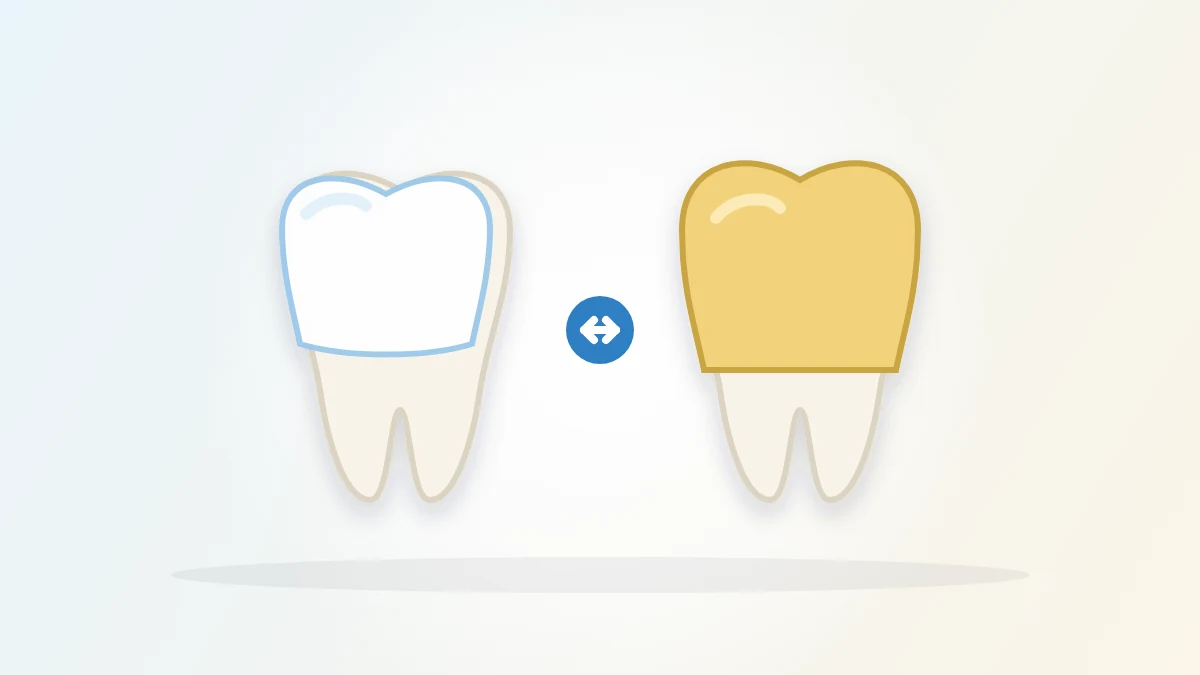
Veneers vs Crowns: 7 Key Differences and How to Choose
Veneers and crowns can both give you a whiter, straighter-looking smile, so it’s easy to mix them up. But they’re built for different jobs. One mainly changes how a healthy tooth looks; the other protects a tooth that’s damaged or weak. Here’s how they compare on purpose, procedure, lifespan and cost.
Quick answer: Veneers vs crowns: a veneer is a thin shell bonded to the front of a tooth to improve its appearance, while a crown is a tooth-shaped cap that covers the whole tooth to protect and strengthen it. Veneers suit healthy front teeth with cosmetic issues. Crowns are better for teeth with large cavities, cracks or a root canal, according to Cleveland Clinic.
Veneers vs Crowns: Side-by-Side Comparison
| Feature | Veneers | Crowns |
|---|---|---|
| What it covers | Front surface of the tooth | The entire visible tooth |
| Main purpose | Cosmetic: color, shape, small gaps or chips | Restorative: protect a damaged or weak tooth |
| Tooth removed | A thin layer of front enamel | More of the tooth, reshaped all around |
| Materials | Porcelain or composite resin | Ceramic, zirconia, porcelain-fused-to-metal, metal |
| How long it lasts | Porcelain up to 20 years; composite 5 to 7 years | 5 to 15 years, sometimes 30 or more with good care |
| Typical cost | Porcelain about $900 to $2,500 per tooth | Varies by material and location |
| Insurance | Usually not covered (cosmetic) | Often partly covered when medically needed |
Veneer lifespan and cost figures are from WebMD; crown figures are from Cleveland Clinic.
What Are Veneers?
Veneers are thin, custom shells bonded to the front of your teeth. Porcelain veneers are the most durable and resist stains best. Composite veneers are made from a tooth-colored resin and can often be done in a single visit, but they don’t last as long.
Veneers work well for:
- Stains that whitening can’t fix
- Small chips or uneven edges
- Minor gaps between front teeth
- Teeth that are slightly misshapen or too small
According to WebMD, veneers aren’t a good fit if you have tooth decay, active gum disease, weak teeth, too little enamel, or you clench or grind your teeth.
What Are Crowns?
A crown is a tooth-shaped cap that fits over the entire tooth. Cleveland Clinic says crowns are used for:
- Large cavities that are too big for a filling
- Cracked, broken or worn-down teeth
- Teeth that have had a root canal
- Covering a dental implant
Getting a crown usually takes two visits: one to shape the tooth and place a temporary crown, and another to bond the permanent crown made by a lab. For a deeper look at materials, see our guide to ceramic crowns.
Veneers or Crowns: Which Should You Choose?
- Choose veneers if your front teeth are healthy and strong and you mainly want to change their color, shape or spacing.
- Choose a crown if the tooth is badly decayed, cracked, worn down or has had a root canal, or if you need to cover an implant.
- For back teeth, crowns are usually the better choice because they handle chewing forces better.
- If cost matters, remember that insurance often helps pay for medically needed crowns but rarely for cosmetic veneers.
Downsides to Know About
Veneers: the process is irreversible because enamel is removed, porcelain veneers can’t be repaired if they crack, the color can’t be changed later and some people have more tooth sensitivity.
Crowns: more of the natural tooth is removed, the tooth may be sensitive for a while, and a crown can loosen or chip over time. A crowned tooth can still get decay at the gum line, so brushing and flossing still matter.
How to Make Them Last
- Brush twice a day and floss daily, especially along the gum line.
- Wear a night guard if you grind your teeth.
- Don’t bite ice, pens or fingernails.
- See your dentist for regular cleanings and checkups. Healthy gums also protect your results, so learn whether gingivitis is contagious.
Frequently Asked Questions
Which lasts longer, veneers or crowns?
Both can last many years. Porcelain veneers can last up to 20 years, while crowns typically last 5 to 15 years and sometimes 30 or more with excellent care.
Are veneers cheaper than crowns?
Not always. Porcelain veneers cost about $900 to $2,500 per tooth, and crowns vary by material and location. Insurance often covers part of a medically needed crown but rarely covers veneers.
Do veneers or crowns damage your teeth?
Both require removing some enamel. Veneers remove a thin layer from the front, while crowns require reshaping more of the tooth. Neither process can be reversed.
Can you get a veneer on a tooth with a root canal?
Usually a crown is recommended after a root canal because the tooth can become brittle and needs full coverage for protection.
Do veneers look more natural than crowns?
Modern porcelain veneers and all-ceramic crowns can both look very natural. Veneers keep more of your own tooth, which some people prefer for front teeth.
The Bottom Line
When it comes to veneers vs crowns, the main question is whether your tooth needs a cosmetic upgrade or protection. Veneers improve the look of healthy front teeth, while crowns cover and strengthen teeth that are damaged, decayed or treated with a root canal. Your dentist can examine your teeth and help you choose the right option.
Sources
- Dental Crowns, Cleveland Clinic
- What Are Veneers?, WebMD
Sources accessed October 7, 2026. This article is general information and isn’t a substitute for advice from your dentist.
